
Fig 3
- ID
- ZDB-FIG-211025-6
- Publication
- Mall et al., 2021 - Heading towards a dead end: The role of DND1 in germ line differentiation of human iPSCs
- Other Figures
- All Figure Page
- Back to All Figure Page
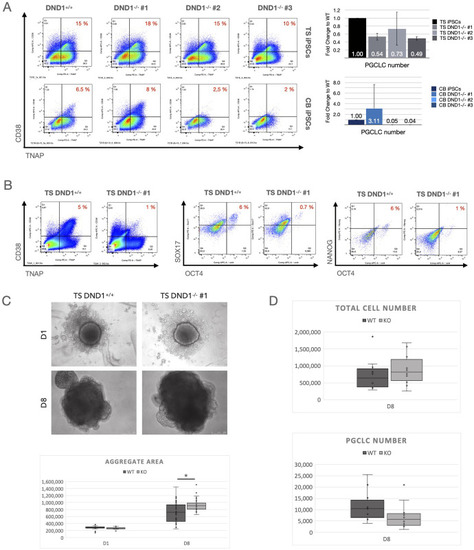
(A) All lines were differentiated using the spin EB method and sorted at D8 for CD38/TNAP double positive PGCLCs. Left: Flow cytometry results shown as dot plots, right: bar graphs with total PGCLC numbers derived. TS DND1-/- hiPSCs resulted in similar ratios but reduced total numbers compared to DND1+/+. CB hiPSCs differentiated less efficiently, and CB DND1-/- #2 & #3 died during PGCLC induction, resulting in low total cell numbers and very few PGCLCs. CB DND1-/- #1 showed efficient differentiation resulting in increased numbers of PGCLCs compared to CB DND1+/+ (n = 3). (B) We verified the results with TS DND1+/+ and TS DND1-/- #1 after aggregation in 96 well plates using staining against CD38/TNAP, OCT4/SOX17 and OCT4/NANOG. All three marker combinations resulted in reduced ratios and absolute numbers of PGCLCs in TS DND1-/- #1 compared to wildtype iPSCs. (C) We measured aggregate sizes (visible area) in D1 and D8 aggregates and found that DND1-/- #1 iPSCs aggregates were bigger compared to the control (n = 3 experiments, with 10 aggregates measured per cell line and experiment). Difference on D8 is significant with * p< 0.01 tested with pairwise t-tests. (D) When we analysed the total cell numbers derived per experiment, TS DND1-/- #1 showed higher total cell numbers while PGCLCs were reduced (n = 10 experiments). Differences in total and PGCLC number did not reach statistical significance between WT and KO cells (pairwise t-test with p<0.05). |