
Fig. 4
- ID
- ZDB-FIG-180110-14
- Publication
- Wiles et al., 2016 - Host Gut Motility Promotes Competitive Exclusion within a Model Intestinal Microbiota
- Other Figures
- All Figure Page
- Back to All Figure Page
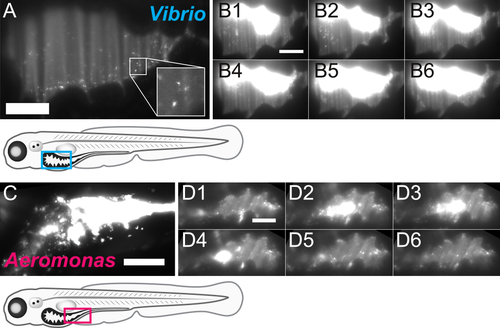
Populations of Vibrio and Aeromonas exhibit different dynamics within the zebrafish intestine. (A) An optical section of the intestinal bulb from a larval zebrafish mono-associated with Vibrio (the cyan box in the diagram below outlines the region imaged). The population consists of discrete, highly motile individuals (inset: single Vibrio cells). (B) A montage of images taken from the time-series in S3 Movie shows that the highly motile and planktonic Vibrio cells maintain their overall distribution despite repeated intestinal contractions. Time between frames: 1 second. (C) An optical section of the intestinal midgut from a larval zebrafish mono-associated with Aeromonas (the magenta box in the diagram below outlines the region imaged). Cells are largely non-motile and densely aggregated. (D) A montage of images taken from the time-series in S7 Movie shows an aggregate of Aeromonas in the midgut that is spatially dynamic, entering and exiting the field of view multiple times. Time between frames: 1 second. (A–D) Scale bars: 50 μm. |