
Fig. 3
- ID
- ZDB-FIG-160824-14
- Publication
- Dang et al., 2016 - Long-term drug administration in the adult zebrafish using oral gavage for cancer preclinical studies
- Other Figures
- All Figure Page
- Back to All Figure Page
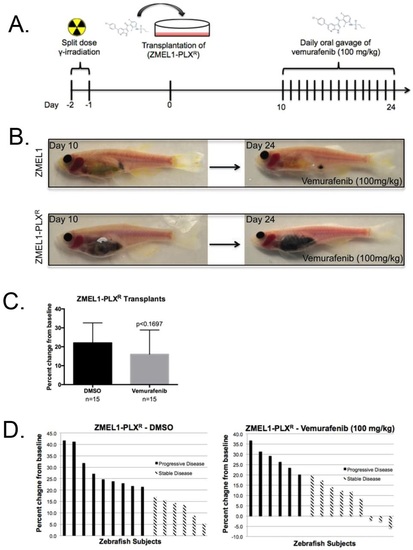
BRAFV600E inhibitor treatment of drug-resistant zebrafish melanoma cell line (ZMEL1-PLXR) transplants. (A) Experimental workflow: MHC caspers were exposed to 30 Gy split-dose of sub-lethal irradiation day -2 and -1 prior to transplantation on day 0. ZMEL1 cells were exposed to low-dose (50¼M) Vemurafenib in culture for 4months to select a drug-resistant population, named ZMEL-PLXR. MHC caspers were transplanted with 500,000 ZMEL-PLXR cells at day 0. Following a 10-day engraftment and proliferation period, the transplanted zebrafish began a two-week regimen of daily oral gavage of DMSO control or 100mg/kg Vemurafenib. (B) The top panels show a representative zebrafish transplanted with drug-naïve ZMEL1 cells in the intraperitoneal cavity at day 10 and the right panel shows the same zebrafish after 2 weeks of daily oral gavage of 100mg/kg Vemurafenib. The bottom panels show a representative zebrafish transplanted with drug-resistant ZMEL-PLXR cells in the intraperitoneal cavity at day 10 and the right panel shows the same zebrafish after 2 weeks of daily oral gavage of 100mg/kg Vemurafenib. (C) Average percent change from baseline of tumor area based on pigmentation in a cohort with n=15 in each treatment arm. Two-tailed paired t-test was performed for statistical analysis. Data represented as mean±s.d. of three replicates. (D) Waterfall plots depict the range of response for the experimental cohorts, DMSO and Vemurafenib. The response was quantified by percent change of tumor area from baseline. |
| Fish: | |
|---|---|
| Conditions: | |
| Observed In: | |
| Stage: | Adult |