
Fig. 7
- ID
- ZDB-FIG-090401-37
- Publication
- Sassi-Messai et al., 2009 - The phytoestrogen genistein affects zebrafish development through two different pathways
- Other Figures
- All Figure Page
- Back to All Figure Page
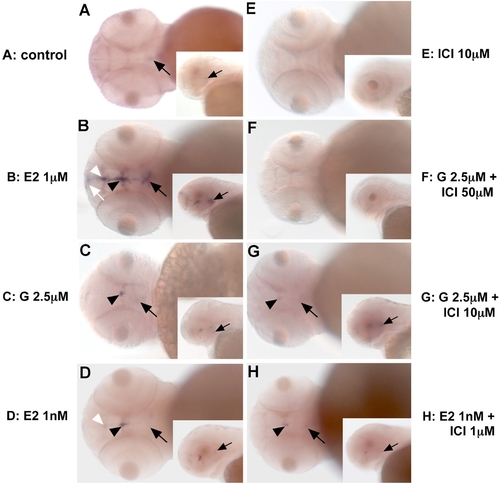
Genistein regulates aromatase-B expression in the brain in an estrogen receptor-dependent manner. In toto in situ hybridization showing the expression of aromatase-B in the zebrafish brain at 48 hpf. (As) Control embryo with weak expression detected in mediobasal hypothalamus (MBH) (arrowheads). (Bs) After genistein exposure, expression is observed in MBH (arrowheads) and in the preoptic area (POA) (arrows). ER antagonists, like ICI, do not induce aromatase-B expression (Cs). The weak staining observed in the MBH in controls is no longer detected in ICI-treated embryos. Cotreatment of genistein and ICI abolishes aromatase-B expression (Ds), but a low dose of ICI does not totally block genistein-induced aromatase-B expression (compare Ds with Es). E2 at high concentrations induces expression of aromatase-B in the MBH (arrowhead), POA (arrow) and in the telencephalon (Tel). When a lower concentration of E2 (1 nM) is used, expression is no longer detected in the anterior brain (Tel) but remains in the MBH (arrowhead) and POA (arrow) as after genistein exposure (compare Gs and Bs). As for genistein, cotreatment of ICI with low concentrations of E2 strongly reduces aromatase-B expression (Hs). |