
- Title
-
Effects of Sunlight Exposure on Tire Tread Particle Leachates: Chemical Composition and Toxicity in Aquatic Systems
- Authors
- Domaoal, J.G., Stack, M.E., Hollman, K., Khanum, S., Cho, C., Daines, A., Mladenov, N., Hoh, E., Sant, K.E.
- Source
- Full text @ Environ. Pollut.

Survival (%) of zebrafish embryos at 4 dpf and Hatch rate (%) of zebrafish embryos at 3 dpf. A steady decrease in overall survival is found in both the (A) 1-day leachate groups exposed to 2.5, 5, 7.5, and 10 g/L TTP leachate and (B) 6-day leachate groups exposed to 2.5, 5, 7.5 g/l TTP leachate. n = 35–79 embryos per group. The incidence of hatched embryos decreased with an increase in TTP concentration and was not reliant on light status or leach duration in (C) 1-day leachates. A similar trend was found in (D) 6-day leachates but a significant difference was found between light and dark groups at the 5 g/L concentration. n = 35–79 embryos per group. Fisher's exact tests were used to assess the significant difference between groups. Asterisks (∗) indicate statistically significant changes from controls (p < 0.05). An octothorpe (#) indicates statistically significant changes from the light group in the same concentration. |
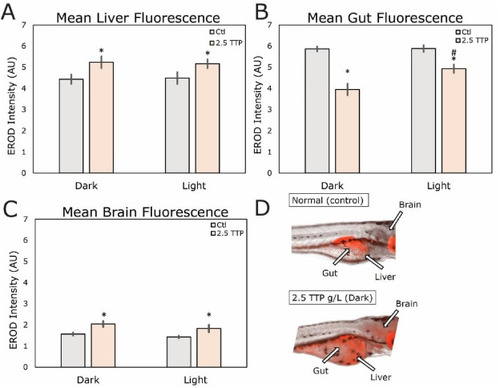
At 3 dpf, embryos were exposed to 6-day leachate (dark or light) at 0 or 2.5 g/L in addition to six μL of 7-Ethoxyresorufin (7-ER). At 4dpf, embryos were evaluated for (D) EROD activity in the liver, gut, and brain. Activity was measured through the intensity of RFP fluorescence. The mean fluorescence intensity was measured and normalized to the background in order to get the (A) mean liver fluorescence, (B) mean gut fluorescence, and (C) mean brain fluorescence. T-tests were used to assess the significant difference between groups. n = 21–37 embryos per group. Asterisks (∗) indicate statistically significant changes from controls (p < 0.05). An octothorpe (#) indicates statistically significant changes from the dark group in the same concentration. |

KEGG pathway changes were observed for TTP (L) and TTP (D) exposure. TTP (L) and TTP (D) gene expression changes were moderately correlated (R2 = 0.405). Divergent responses occurred in the second and fourth quadrant and were related to carbohydrate metabolism, glycan biosynthesis, and genetic information processing. Gene expression was compared between all conditions. A total of 1021 and 1039 genes were significantly changed (p < 0.05) by TTP (L) and TTP (D) exposure, respectively, while a total of 839 genes were significantly changed similarly in both. A total of 10 genes were significantly changed between all 4 conditions. |

Heatmaps produced with hierarchical clustering using a) 546 chromatographic features and b) 71 tentatively identified compounds, both detected across all leachates. The sample ID indicates the light condition, the leaching time, and the replicate number. |