FIGURE SUMMARY
Title

Identification and characterization of amphibian SLC26A5 using RNA-Seq

Authors
Wang, Z., Wang, Q., Wu, H., Huang, Z.
Source
Full text @ BMC Genomics

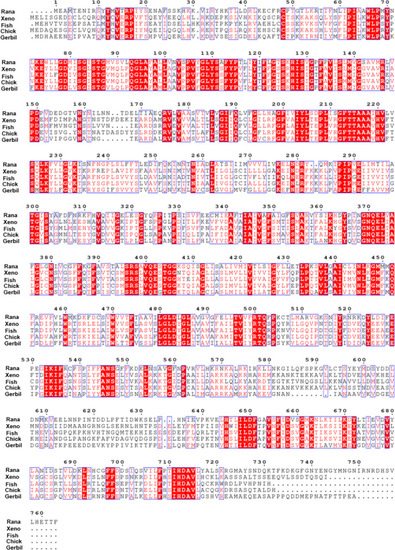
Alignment of amino acid sequences of rana (American bullfrog), xeno (tropical clawed frog), fish (zebrafish), chick and gerbil prestin. Different colors had been used to represent identity of each residue among two species. Red block: Full identity at a residue; red letter: Partial identity at a residue; Black: complete disparity at a residue. Gaps in the aligned sequences were indicated by the dashed line

Frog prestin localized in the cell membrane. A Donor vector (upper one) designed for expression of ranaprestin-EGFP fusion protein and CRISPR/Cas9-mediated gene editing vector (lower one). B Membrane expression of rana prestin (rPres) in HEK293T cells was examined using confocal microscopy. The left one was a detached cell and the right one was an attached cell. C Predicted protein structure of rana prestin (left). The transmembrane domain holds two intertwined inverted repeats of seven TM segments. The N- and C-terminal halves of the TM domain are green and pink, respectively. The STAS domain is within the purple part. Predicted protein structure of gerbil prestin (right)

The nonlinear capacitance measurements in the hair cells from bullfrog’s amphibian papilla (AP) and in the exogenous expressed cells. A The voltage-clamped hair cell was depolarized from a holding potential of -80 mV to -20 mV. During the depolarizing stimulus, a Ca2+ current was recorded. After the Ca2+ current was blocked by the Cd2+ at a concentration of 0.4 mM. B Voltage steps (300 ms in duration) varied from − 150 to 100 mV in 10 mV steps were used for capacitance recordings. C Non-linear capacitance obtained from the hair cells of rana’s AP and D from the rana prestin transfected cells

NLC datas of rana’s amphibian papilla (AP) hair cells and rana prestin transfected cells (rPres). A, B, C, D Showed four parameters derived from curve fittings with Boltzmann’s function for AP hair cells (n = 8) and rPres (n = 8). Datas were expressed as mean ± s.d. *P < 0.05, **P < 0.01

NLC measurements from rana, xenopus and chick. A Non-linear capacitance obtained from the HEK293T cells expressing rana prestin. B Non-linear capacitance obtained from the HEK293T cells expressing xenopus prestin. C No NLC obtained from the HEK293T cells expressing chick prestin. D This one showed the lack of detectable NLC in a negative control cell

Comparing the NLC datas of xenopus prestin with rana prestin. A, B, C, D) Showed four parameters derived from curve fittings with Boltzmann’s function for the cells (n = 12). Datas were expressed as mean ± s.d. *P < 0.05, **P < 0.01

Acknowledgments
This image is the copyrighted work of the attributed author or publisher, and ZFIN has permission only to display this image to its users. Additional permissions should be obtained from the applicable author or publisher of the image. Full text @ BMC Genomics