
IMAGE

Fig. 7.

ID
ZDB-IMAGE-250828-133
Source
Figures for Wheelan et al., 2025
Image
Figure Caption

Fig. 7.

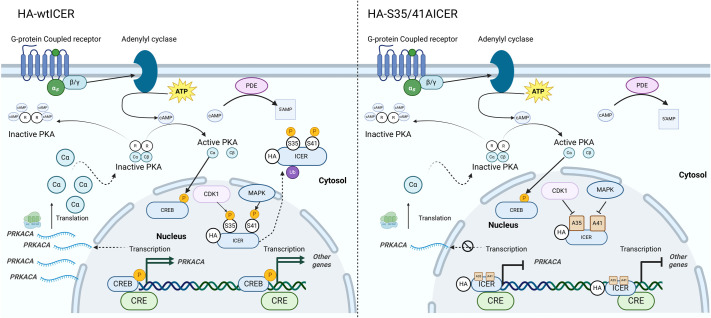
Proposed Model of PRKACA regulation via ICER. Proposed model showing how wtICER (left) and the phosphorylation deficient S35-41-ICER (right) may impact gene expression, and specifically PRKACA, encoding the alpha catalytic subunit of PKA. Following adenylyl cyclase conversion of ATP to cAMP, 2 cAMP molecules bind to each PKA regulatory subunit, releasing the now active catalytic subunits, which phosphorylate CREB among other targets. Active CREB binds to CREs on the PRKACA promoter, upregulating gene expression of this subunit, which in turn, can more readily phosphorylate CREB in the presence of additional cAMP secondary messenger signal, forming a positive feedback loop. On the left, ICER is shown, in this case, to be phosphorylated on serine's 35 and 41, and subsequently ubiquitinated and removed to the cytosol. ICER in the example shown is not poly-ubiquitinated or degraded due to the presence of an HA-tag which prevents N-terminal recognition by UBR4. On the right, we show the phosphorylation deficient ICER is now unable to be phosphorylated, and therefore not ubiquitinated. In this environment, ICER competitively binds to CRE's on the promoter of many genes, including PRKACA and inhibits expression. In the case of PRKACA transcriptional repression by ICER, expression of the PKA catalytic subunit is decreased, decreasing the amount of phosphorylated and active CREB.

Acknowledgments
This image is the copyrighted work of the attributed author or publisher, and ZFIN has permission only to display this image to its users. Additional permissions should be obtained from the applicable author or publisher of the image. Full text @ Biol. Open