
|
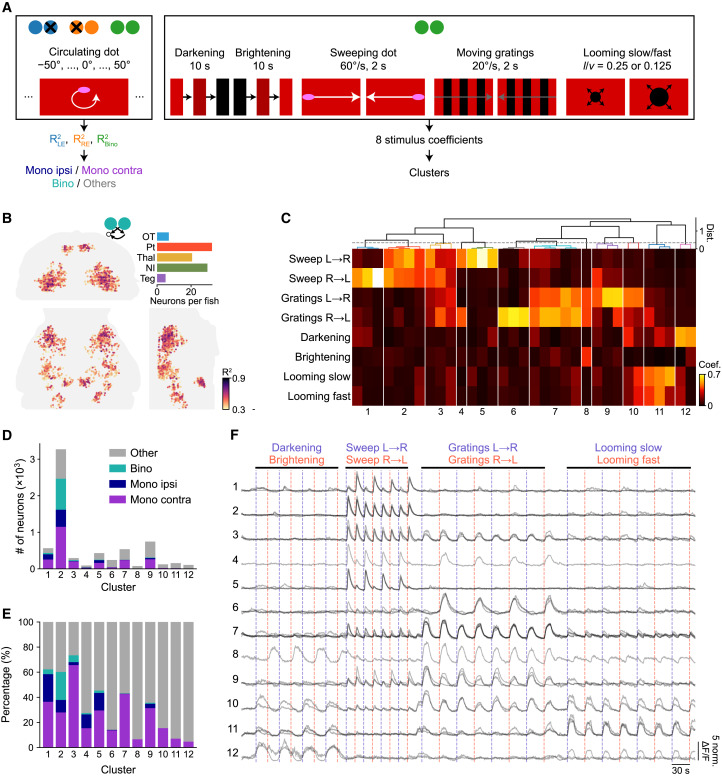
Fig. 3 Bino-PRNs respond specifically to prey stimuli (A) Schematic of the stimulus protocol. Circulating UV prey-like stimuli were presented on a red background in different ocular conditions, and a battery of eight other types of stimuli were presented binocularly to assess the specificity of bino-PRNs. (B) Bino-PRNs were found in the Pt, Thal, and NI, using the same method as in Figure 2. (C) Hierarchical clustering revealed 12 clusters that responded primarily to prey, moving gratings, or looming stimuli. (D and E) Number and percentage of neurons in each cluster that are bino- or mono-PRNs. (F) Calcium traces of all exemplars (gray) from each cluster. Blue and red vertical lines represent repeats of the two different stimuli within each stimulus category. Different shades of gray represent the activity of different subclusters within each cluster shown in (C) (n = 10 fish).