
Fig. 6
- ID
- ZDB-IMAGE-250730-80
- Publication
- Ingham et al., 2025 - Loss of SLX4IP leads to Common Fragile Sites instability and compromises DNA interstrand crosslink repair in vivo
- All Figures
- Figures for Ingham et al., 2025
|
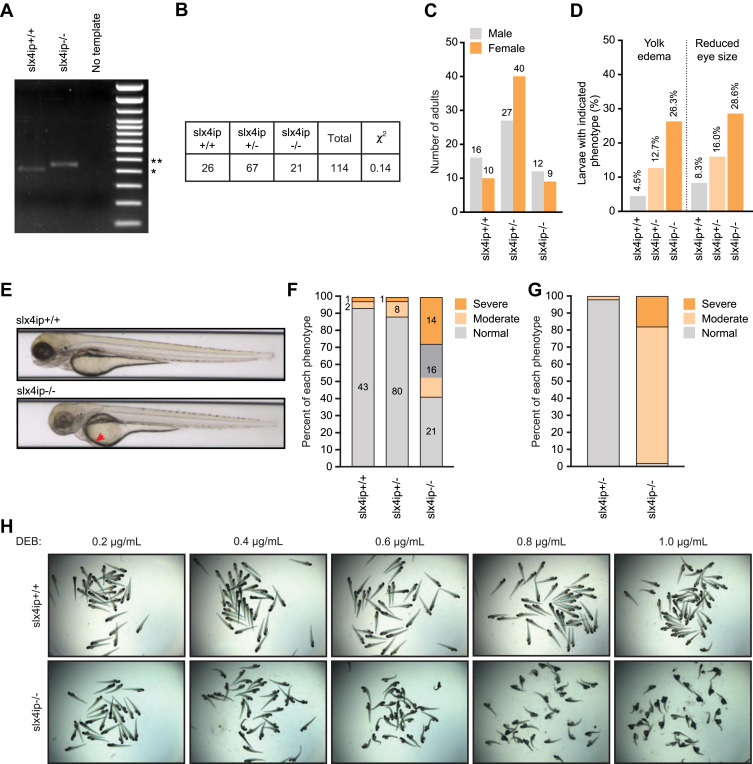
Fig. 6 Evaluation of slx4ip knockout zebrafish for survival, growth, and response to a DNA crosslinking agent. A, image of wildtype (slx4ip+/+) and knockout (slx4ip−/−) allele RT-PCR products resolved on 2% agarose gel. The mutant allele product has expected 40 bp insertion and no other aberrant splice product. Bands 400 bp and 500 bp marked by ∗ and ∗∗, respectively. B, data from genotyped adults indicates normal Mendelian birth ratios for wildtype, heterozygous (slx4ip+/−) and knockout zebrafish. C, data from genotyped adults by gender, indicating no female-to-male sex reversal bias in knockouts. D, phenotypical analysis of zebrafish larvae of indicated genotypes reveal higher rates of yolk sac edema and eye size reduction in larvae devoid of slx4ip. E, representative images of zebrafish larvae of indicated genotype. The red arrow demonstrates yolk edema. F, results of heterozygous incross to assess hypersensitivity of embryos to the administration of 1.0 μg/ml DEB, with phenotype-based separation at 72 hpf. G, results of heterozygous fish crossed with knockout fish to assess hypersensitivity to administration of 0.8 μg/ml DEB, with phenotype-based separation at 120 hpf. H, representative images of progenies from wildtype incross and knockout incross imaged at 120 hpf, after administration of varying concentrations of DEB.