
IMAGE

Figure 1

ID
ZDB-IMAGE-250609-68
Source
Figures for Chamera et al., 2025
Image
Figure Caption

Figure 1

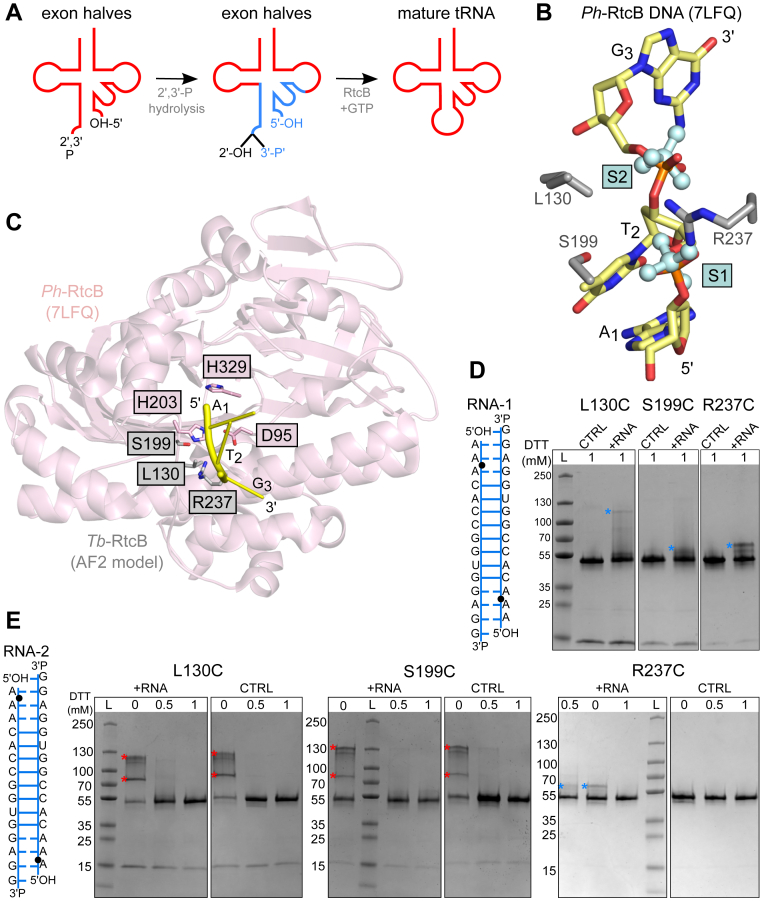
Chemical crosslinking of Tb-RtcB and RNA.A, schematic representation of the ligation reaction performed by RtcB. Blue part corresponds to the fragment that was used for the design of RNA substrates for chemical crosslinking. B, structural analysis. AlphaFold 2 model of Tb-RtcB, structure of Ph-RtcB (PDB ID: 4ISJ), and structure of Ph-RtcB–DNA complex (PDB ID: 7LFQ) were superimposed. The panel shows sulfate (S1, S2) ions from 4ISJ structure (cyan), amino acid residues from the Tb-RtcB AlphaFold 2 model predicted to interact with RNA (shown as gray sticks), and DNA from Ph-RtcB–DNA complex structure (shown in yellow). C, same superposition as in (B) but with Ph-RtcB–DNA complex structure (PDB ID: 7LFQ) shown in pink cartoon for protein and DNA in yellow. Selected residues of AlphaFold 2 model of Tb-RtcB are shown as gray sticks. Active site residues of Ph-RtcB are shown as pink sticks. D and E, SDS-PAGE analysis of results of the cross-linking reactions of the Tb-RtcB mutants and the cystamine-modified RNA substrates. A schematic representation of the substrates is shown on the left side of the gels. Black dot represents the cystamine modification. In all cases, the blue asterisks mark specific crosslinks, whereas the red asterisks mark unspecific or protein–protein crosslinks. CTRL stands for reactions with protein only. L, molecular weight ladder; PDB, Protein Data Bank; Ph-RtcB, Pyrococcus horikoshii RtcB; Tb-RtcB, RtcB from archaeon Thermococcus barophilus.

Acknowledgments
This image is the copyrighted work of the attributed author or publisher, and ZFIN has permission only to display this image to its users. Additional permissions should be obtained from the applicable author or publisher of the image. Full text @ J. Biol. Chem.