
Fig. 3
- ID
- ZDB-IMAGE-130516-24
- Publication
- Schuler et al., 2013 - Ciliated sensory hair cell formation and function require the F-BAR protein syndapin I and the WH2 domain-based actin nucleator Cobl
- All Figures
- Figures for Schuler et al., 2013
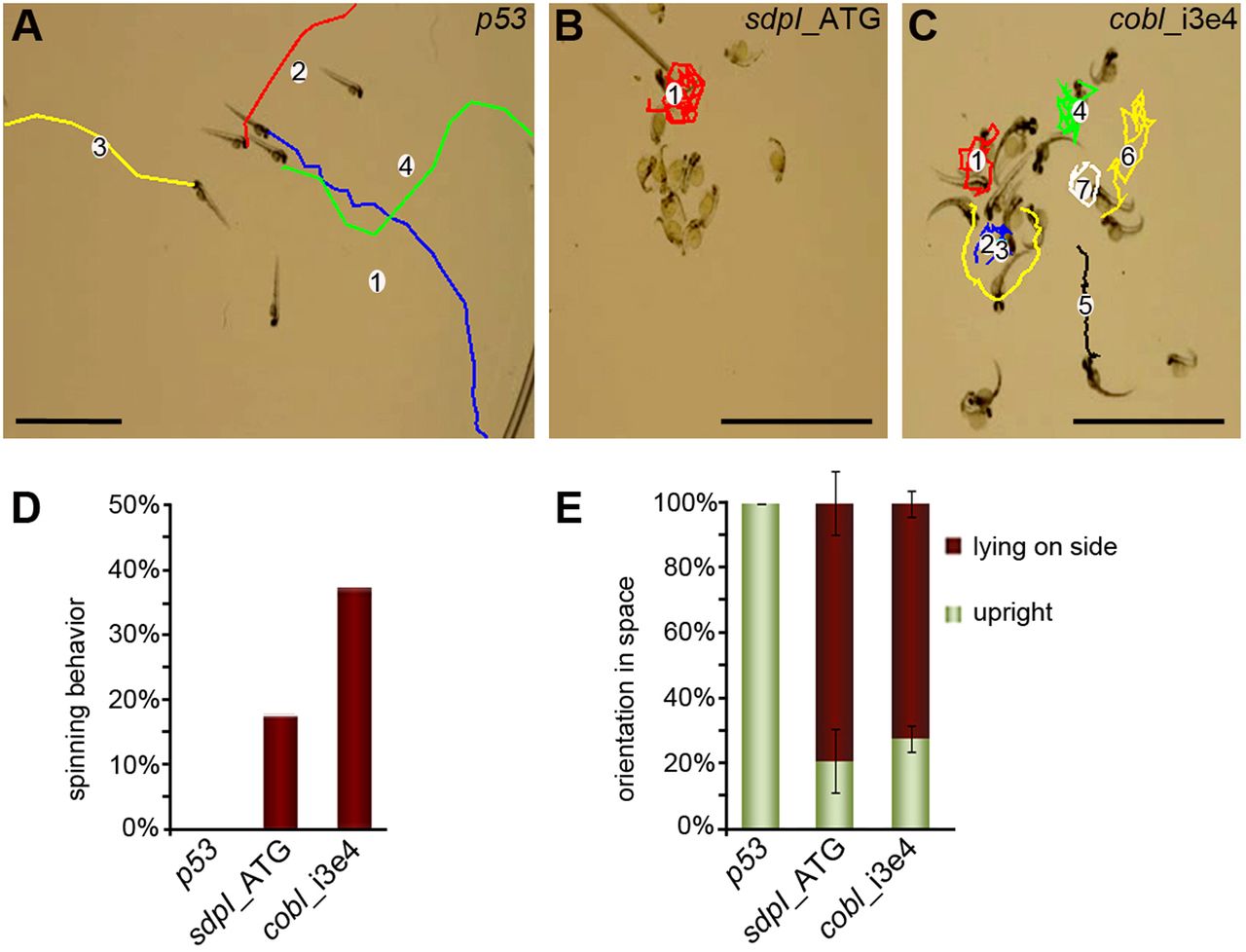
|
Fig. 3 Cobl and syndapin I morphants are paralyzed or display uncoordinated movements and fail to keep their balance. (A–C) Dechorionated control-injected embryos (48hpf) show typical directed escape responses after tactile stimulation (A), whereas syndapin I (B) and cobl (C) morphants did not respond or moved in an uncoordinated spinning manner. The swim paths of moving fish (numbered) are depicted. Note that both cobl- and syndapin I-morphant fish also often lie on their side. Scale bars: 5mm. (D) Quantification of the percentage of fish showing uncoordinated spinning behavior [control-injected (MO p53), n = 28; MO sdpI_ATG, n = 18; MO cobl_i3e4, n = 77 animals]. (E) Quantitative analysis of balance keeping after tactile stimulation. SdpI- and cobl-morphant embryos lie on their sides and fail to orientate upright (MO p53, n = 10; MO sdpI_ATG, n = 40; MO cobl_i3e4, n = 24; two independent experiments at 48 hpf).