
Fig. 1
- ID
- ZDB-FIG-260207-1
- Publication
- Akhter et al., 2025 - KLHL13 functional defects cause neurodevelopmental disorder in humans that can be rescued via inhibition of AURKB in cellular and animal models
- Other Figures
- All Figure Page
- Back to All Figure Page
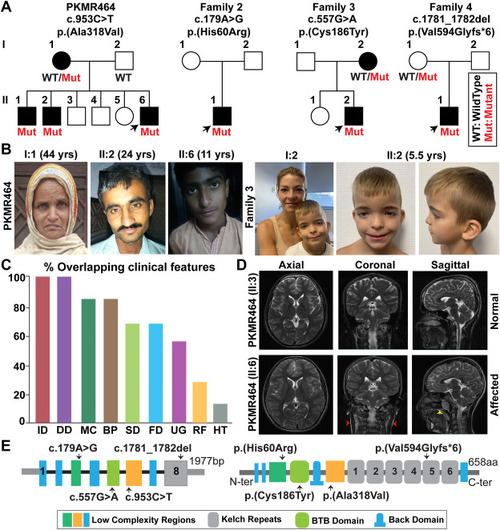
Hemizygous rare variants in KLHL13 are associated with intellectual disability, developmental delay, hypotonia, macrocephaly, and dysmorphic facial features. A. Pedigrees of families from different ethnicities segregating NDD-associated phenotypes with maternally inherited variants in the X-linked KLHL13 gene. Filled symbols represent affected individuals, and genotypes for the identified variants are given below the symbols of the participating individuals. The black arrow represents the proband. B. Photographs of affected individuals (I:1, II:2, and II:6) of PKMR464 and family 3 (I:2, and II:2) revealed dysmorphic facial features, including broad nasal bridge, short philtrum, triangular mouth, highly arched eyebrows, hypertrichosis of the eyebrow, broad nasal tip, protruding low-set ear, broad forehead, hypertelorism, hypoplasia of maxilla, facial hypotonia, and down slanting palpebral fissures, and thin upper lips. C. Percentages and prevalence of different NDD-associated clinical features that are variably expressed in individuals harboring KLHL13 variants. BP, behavioral problems; DD, developmental delay; FD, facial dysmorphism; HT, hypotonia; ID, intellectual disability; MC, macrocephaly; RF, rare clinical features; SD, speech delay; UG, unsteady gait. D. Brain MRI of the normal (II:3) and affected individual (II:6) of family PKMR464. The red arrows represent a larger head-to-neck area, whereas the yellow arrow shows mucus retention cysts in the bilateral maxillary sinuses. E. Structural representation of the human KLHL13 gene and encoded protein, along with 4 variants identified in our cohort. |