
Fig. 2
- ID
- ZDB-FIG-241120-8
- Publication
- Moya-Díaz et al., 2024 - Substance P and dopamine form a "push-pull" system that diurnally regulates retinal gain
- Other Figures
- All Figure Page
- Back to All Figure Page
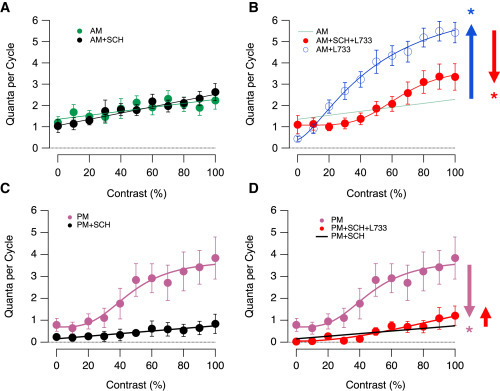
Substance P inhibits dopamine signaling (A) Dopamine was inactive in the morning. Contrast-response functions of BC synapses in the morning, before (green, n = 26) and after (black, n = 26) injection of the D1 antagonist SCH 23390 (∼20 nM). ON and OFF synapses pooled because neither showed a significant change (p > 0.84, KS test). Each point shows the mean ± SEM. (B) Dopamine became active when substance P signaling was suppressed. In the morning, injection of the NK1 antagonist L-733,060 alone (∼20 nM) significantly increased the CR function (blue arrow; n = 23; p < 0.003, KS test) compared with control (green line, from A). In contrast, the addition of SCH 23390 significantly suppressed the CR function measured when antagonizing NK1Rs (red arrow; n = 26; p < 0.003, KS test). (C) Dopamine was active in the afternoon. CR functions before (pink, n = 10) and after (black, n = 10) injection of SCH 23390. (D) Antagonizing D1 receptors suppressed the CR function (pink arrow; p < 10−5, KS test). Subsequent addition of L-733,060 had no significant effect (red; n = 10), indicating that the decreased responses did not involve a suppressive action of substance P. See also Figure S2. |