
Fig. 1
- ID
- ZDB-FIG-240606-26
- Publication
- Beckmann et al., 2024 - Assessment of a novel NRAS in-frame tandem duplication causing a myelodysplastic/myeloproliferative neoplasm
- Other Figures
- All Figure Page
- Back to All Figure Page
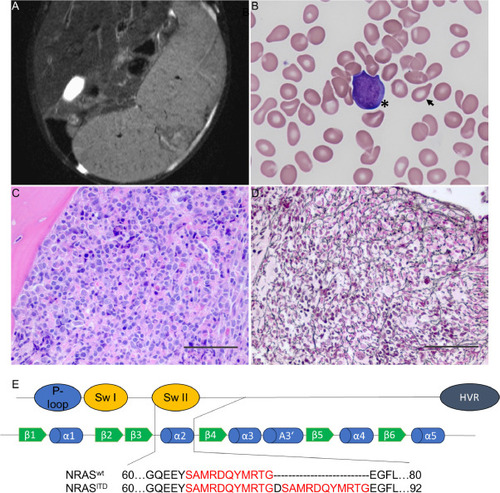
Phenotype of the affected child and the novel NRASITD mutation. (A) The 2.5-year-old child suffered from a severe hepatomegaly and especially splenomegaly as shown in the magnetic resonance image (T2 sequence with fat saturation). (B) In peripheral blood smears taken at first presentation to our clinic, blast cells (asterisk) were found as well as dacrocytes (arrow) as a sign of myelofibrosis. (C) The trephine biopsy specimen obtained showed hypercellular bone marrow (hematoxylin and eosin stain, 400 ×) with hyperplasia of a left-shifted granulopoiesis, hypoplasia of the erythropoiesis (scale bar: 50 µm), and (D) myelofibrosis (Gomori's silver staining, 400 ×, scale bar: 50 µm). (E) In the patient's bone marrow, the somatic NRASITD mutation was found by Sanger sequencing, leading to a duplication of 11 amino acids. Shown is an alignment to the GTPase NRAS Homo sapiens Sequence ID: NP 002515.1 using BLASTp (NCBI) [17,18]. The location of the duplication in correlation to the P-loop, switch I (Sw I) and switch II (Sw II) domains, and the hypervariable region (HVR) of the NRAS protein is shown. Underneath, the secondary structural elements of the NRAS protein are shown as green arrows and blue cylinders representing β-sheets and α-helices, respectively [16]. |