
FIGURE 2
- ID
- ZDB-FIG-220803-6
- Publication
- Tayanloo-Beik et al., 2022 - Zebrafish Modeling of Autism Spectrum Disorders, Current Status and Future Prospective
- Other Figures
- All Figure Page
- Back to All Figure Page
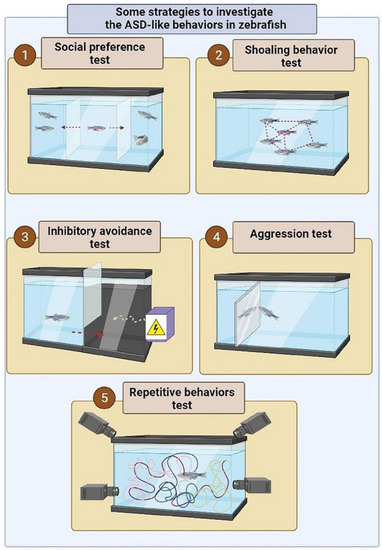
Some strategies to investigate the ASD-like behaviors in zebrafish. (1) In order to assess social preferences, a live zebrafish or robot or photo or zebrafish video is used in an adjacent tank or multi-chamber tank to show the conspecific fish. In this experiment, the social preference behavior is examined by measuring the distance of the fish from the conspecific fish (photo, video, or robot) in the adjacent tank. (2) In order to investigate shoal behavior in the zebrafish, the studied model is placed among a group of conspecific fish inside a tank. In this experiment, the incidence of shoal behavior is determined based on the average distance between the fish in a tank. (3) In order to investigate behavioral avoidance, one of the chamber of the tank becomes dark, which is instinctively more desirable for zebrafish than a brighter environment. However, the presence of the electric shock in a dark environment is considered a risk factor for zebrafish. Hence the conflict between swimming into the dark environment instinctively and avoiding electric shock can be used to investigate behavioral avoidance. (4) In order to assess the aggression behavior, a mirror is applied inside the tank of the zebrafish. (5) The locomotor behavior can be assessed by tracking the position of zebrafish in 3D space and swim path characteristics ( |