
Figure 3
- ID
- ZDB-FIG-211122-22
- Publication
- Beppi et al., 2021 - Light-stimulus intensity modulates startle reflex habituation in larval zebrafish
- Other Figures
- All Figure Page
- Back to All Figure Page
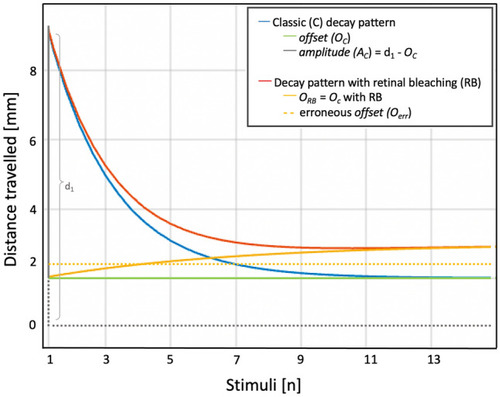
Depiction of the input of retinal bleaching (RB) to the startle habituation, using simulated data. In the classic decay model (blue) described by Beppi et al.35, the amplitude (AC) corresponds to the magnitude of the locomotor response to the first stimulus (d1) minus the offset (OC), namely the steady-state responsivity (constant). The decay pattern with RB accounts for the effect of retinal bleaching with decay to an asymptotically increasing offset (ORB). Habituation is a high-pass filter [AC × exp(Dc × n)], where Dc is the decay constant and n the stimulus number minus 1. The bleaching effect is instead a low-pass filter [ARB × exp(–n / Rc)] where Rc is the rise constant and is larger than Dc (in this example Dc = 1 and Rc = 3), while ARB (= d1 – ORB) is considerably smaller than AC. The habituation with bleaching effect can hence be described as [AC × exp(Dc × n) + ARB × exp(–n / Rc) + OC]. When trying to fit a classic first-order exponential into such a decay pattern with retinal bleaching, a “fictitiously” high average (i.e., constant) offset (Oerr) and a “fictitiously” smaller amplitude (Aerr = d1 – Oerr) would be obtained, as we can observe in Figure 2 (see offsets and amplitudes in the highest lux-levels). |