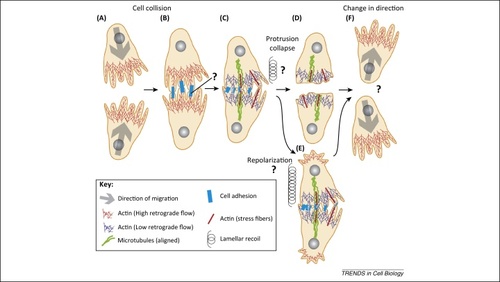
Contact inhibition of locomotion. (A) Freely migrating cells show high actin retrograde flow in their lamellae. (B) The lamellae come into contact with each other and a cell-cell adhesion complex forms between the cells. (C) The rate of actin retrograde flow slows in the region behind the cell-cell adhesion, which allows for the formation of actin stress fibres in these regions, followed by microtubule bundles. The actin fibres from colliding partners align via cell-cell adhesion and elastic tension (spring) builds up in the lamellae. (D) This localized increase of tension (spring) in the lamella is released by breaking down the adhesion complex. (E) Alternatively, when the cells are still in contact they repolarise away from the site of contact, generating tension (spring) across the whole cell body as both cells pull away, leading to the breakdown of the adhesion complex. (F) Once the adhesion complex is disassembled, the cells move away from each other. Question marks highlight key processes that take place during contact inhibition that require further investigation.
|
