
Fig. 1
- ID
- ZDB-FIG-170901-20
- Publication
- Duboué et al., 2017 - Left Habenular Activity Attenuates Fear Responses in Larval Zebrafish
- Other Figures
- All Figure Page
- Back to All Figure Page
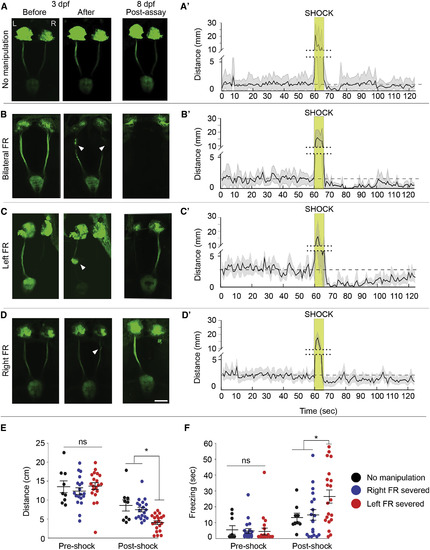
Intact Left dHb-IPN Pathway Required to Mitigate Fear Behaviors (A–D) Live imaging of TgBAC(gng8:nfsB-EGFP-CAAX) larvae with the Hb-IPN pathway intact (A) or before and after bilateral (B), left (C), or right (D) (white arrowheads) severing of the fasciculus retroflexus (FR) at 3 d. FR lesions were confirmed at 8 d following behavioral testing. The left (L) and right (R) dHb are indicated. Scale bar, 50 μm. dpf, days post fertilization. (A′–D′) Corresponding locomotor activity measured in 1-s intervals pre and post shock. Mean activity (solid black lines) relative to pre-shock levels (dashed lines) and SE (light gray) are indicated. The y axis is split (dotted lines) to include heightened activity during shock (gold boxes). (E and F) Locomotor activity (E) was decreased in larvae with the left FR severed (n = 20; Kruskal-Wallis ANOVA H = 54.35, p < 0.0001; Dunn’s post test; p < 0.05) relative to uncut controls (n = 9) or those with the right FR severed (n = 19), and duration of freezing (F) also increased (n = 20; Kruskal-Wallis ANOVA H = 35.75, p < 0.01; Dunn’s post test, p < 0.05). Horizontal bars representing mean ± SEM for 1-min intervals pre and post shock are superimposed over scatterplots of individual larvae (circles). No significance (ns) and significance below p = 0.05 (∗) are noted. See also Figures S1 and S2. |