
Fig. 3
- ID
- ZDB-FIG-120305-7
- Publication
- McClenahan et al., 2012 - Fin-Tail Coordination during Escape and Predatory Behavior in Larval Zebrafish
- Other Figures
- All Figure Page
- Back to All Figure Page
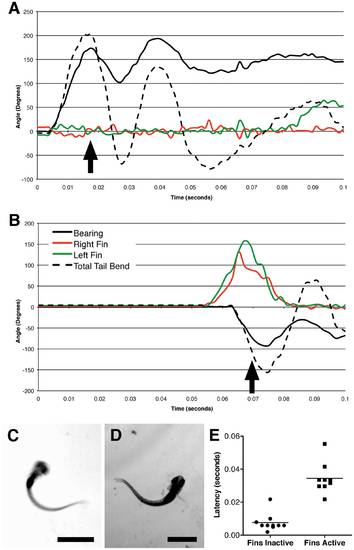
Pectoral fin involvement in long-latency, but not short-latency startle. Charts representing typical short-latency (Panel A) and long-latency (Panel B) startle responses are shown. In short-latency startle responses, the fins remain adducted during the C-bend and counter bend. Both pectoral fins are abducted and adducted in unison during the C-bend and counter bend of long-latency startles. Individual frames from a short-latency (Panel C) and a long-latency startle (Panel D) are shown, with the approximate times of the frames indicated by the arrows in Panels A and B. Panel E shows a scatter plot of startle events with and without fin involvement, and the latency to respond to the stimulus. n = 9 for responses with active fins and 10 for inactive fins, and p<0.0001 (two-tailed unpaired t-test). Scale bars in C and D indicate 1 mm. The larvae shown are 7 dpf. |