
Fig. 1
- ID
- ZDB-IMAGE-261124-465
- Publication
- Benítez-Santana et al., 2017 - Role of Intestinal LXRα in Regulating Post-prandial Lipid Excursion and Diet-Induced Hypercholesterolemia and Hepatic Lipid Accumulation
- All Figures
- Figures for Benítez-Santana et al., 2017
|
Fig. 1
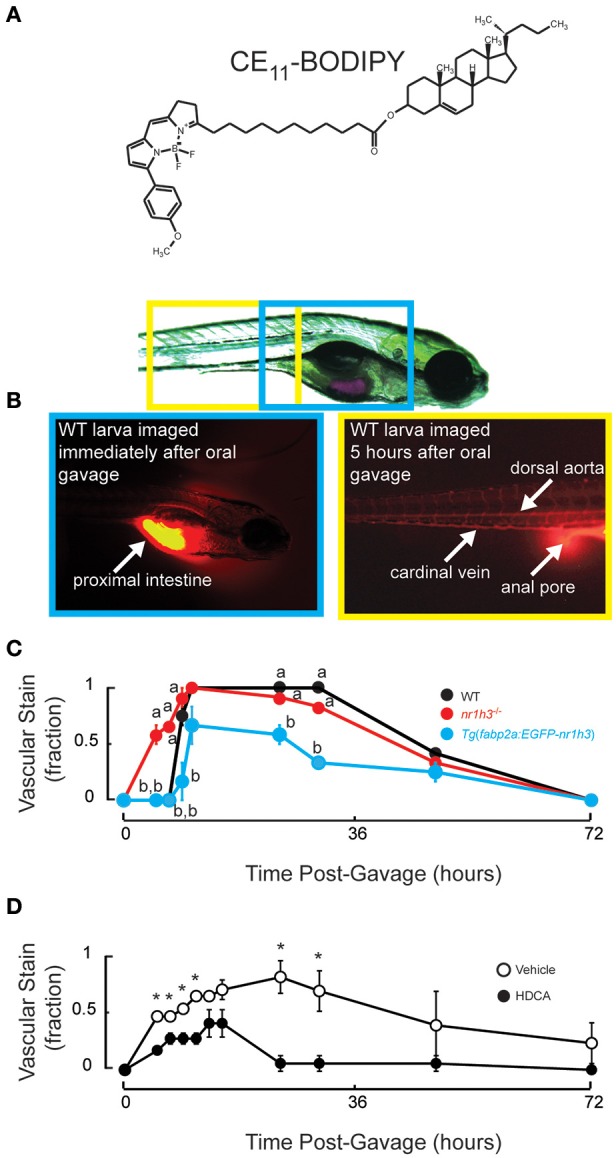
Genetic activation of intestinal Lxrα regulates the pace of transport of ingested lipids in larvae. (A) Structure of CE11-BODIPY. (B) A 7 days post-fertilization (dpf) larva following oral gavage of a mixture of triolein, cholesteryl oleate and CE11-BODIPY (upper). Immediately after oral gavage, the fluorescent signal is very strong in the anterior intestine (lower left). Within 5 h of gavage, strong vascular staining is apparent, and excess (not absorbed) label can be seen passing through the anal pore (lower right). (C) Six dpf WT, nr1h3−/−, and Tg(fabp2a:EGFP-nr1h3) transgenic larvae underwent gavage with the lipid mixture, and were scored for the appearance of lipids in the vasculature in a blinded fashion. Values not sharing a common superscript letter are significantly different at P < 0.05 at each time point in 2-sided student t-tests vs. WT; n = 18 for each genotype. (D) Five dpf WT larvae underwent gavage with vehicle or HDCA. Twenty-four hours later larvae were gavaged with the lipid mixture, and were scored for the appearance of lipids in the vasculature in a blinded fashion. *P < 0.05 at each time point in 2-sided student t-tests vs. WT; n = 18 for each genotype.