
Figure 3
- ID
- ZDB-IMAGE-260623-14
- Publication
- Capecki et al., 2026 - Evidence that disruption of Discoidin domain receptor 2 contributes to palate malformations through effects on the extracellular matrix
- All Figures
- Figures for Capecki et al., 2026
|
Figure 3
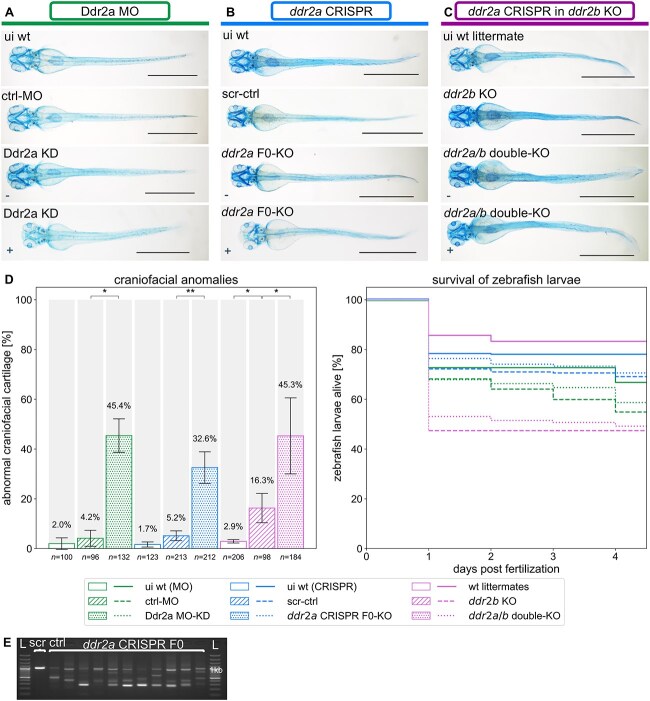
Phenotype classification of Alcian blue-stained zebrafish larvae (zfl). N = 3 independent experiments per group. (A–C) dorsal view of whole-mount zfl at 4 dpf. Uninjected and control-injected littermates are presented alongside the KD and KO for each experimental group: Ddr2a Morpholino-knock-down (MO-KD) and controls (ctrl-MO); ddr2a CRISPR F0-knock-out (CRISPR F0-KO) and controls (scr-ctrl); ddr2a/b double-KO and uninjected ddr2b KOs, alongside with their wildtype littermates. Zfl were separated into two categories: Those showing abnormal structures of the ethmoid plate and/or trabeculae (+) and those not showing any clear craniofacial alterations (−). Scale bars, 1000 μm. (D) left: Bar-graph showing the statistical occurrence of an abnormal craniofacial cartilage in different KD and KO zfl compared with uninjected and control-injected littermates. Experimental groups, as described in (A-C). The percentage of detected anomalies is given above the corresponding bar. *P < 0.05, **P < 0.005, ***P < 0.0005. Error bars represent the standard deviation. n, number of zfl. Right, Kaplan-Meyer graph displaying zfl survival curves from fertilization to 4 dpf. (E) PCR analysis of genomic DNA from ddr2a CRISPR and scr-ctrl injected zfl at 4 dpf to validate the CRISPR F0-KO. The expected PCR product in an undisrupted gene is approximately 1 kb; in case of successful CRISPR F0-KO, bands should be of unspecified different mobilities. L, ladder.