
Fig. 1
- ID
- ZDB-IMAGE-260501-1
- Publication
- Szenker-Ravi et al., 2024 - CIROZ is dispensable in ancestral vertebrates but essential for left-right patterning in humans
- All Figures
- Figures for Szenker-Ravi et al., 2024
|
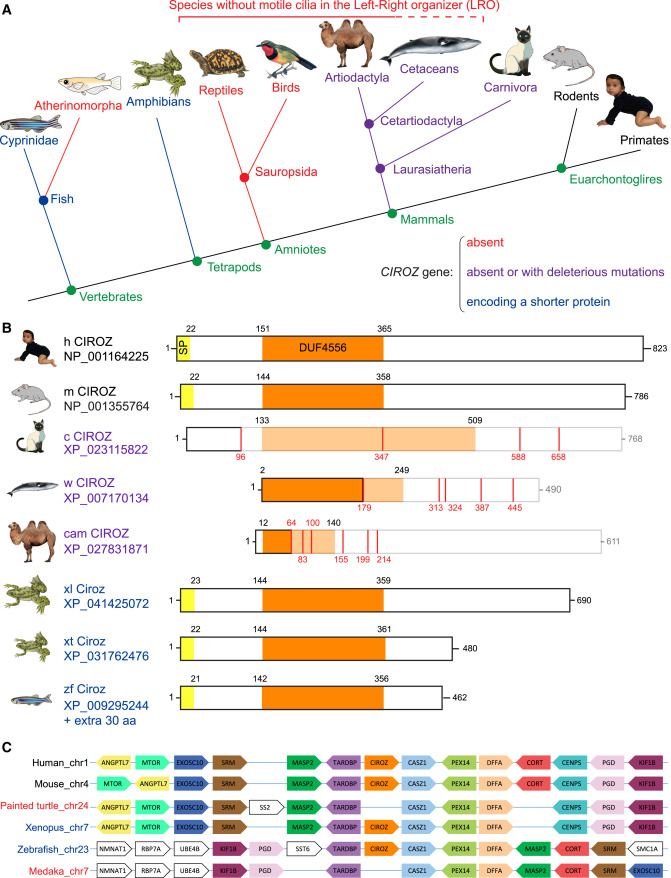
Fig. 1 Pseudogenization of CIROZ in laurasiatherian mammals, reptiles, and birds (A) Simplified evolutionary tree of vertebrate species. The dashed red line indicates that the absence of motile cilia at the LRO has not yet been shown experimentally in cetaceans, as opposed to birds (chicken), reptiles (gecko), and Artiodactyla (pig). The red lines indicate where the CIROZ gene has been lost, the purple lines where it has accumulated deleterious mutations during evolution, and the blue lines where it encodes a shorter protein. Informed consent from the parent was obtained to publish the photograph of the toddler. (B) CIROZ schematic structures in human (Homo sapiens [h]), mouse (Mus musculus [m]), cat (Felis catus [c]), whale (Balaenoptera acutorostrata scammoni [w]), camel (Camelus bactrianus [cam]), Xenopus laevis (xl), Xenopus tropicalis (xt), and zebrafish (Danio rerio [zf]). Red lines indicate premature stop or frameshift variants. (C) Representation of the CIROZ locus in representative jawed vertebrates whose genomes have been sequenced, showing the loss of the gene in turtles (Reptilia) as well as in medaka (fish). Block arrows represent genes, with the direction of arrows denoting transcriptional orientation. Orthologous genes are shown with the same color.