
Fig. 2
- ID
- ZDB-IMAGE-260428-17
- Publication
- Usami et al., 2026 - C-mannosyltransferase Dpy19l1l regulates body axis formation via secretion of SCO-spondin in zebrafish
- All Figures
- Figures for Usami et al., 2026
|
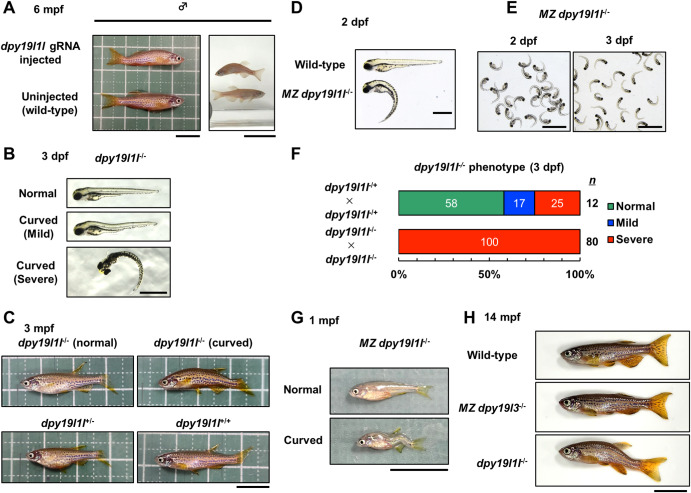
Fig. 2 Knockout of Dpy19l1l maternally induces a scoliosis-like "curly tail down" phenotype. A, Lateral view of dpy19l1l gRNA injected fish at 6 mpf. Scale bar; 1 cm. B, Lateral view of Dpy19l1l KO zebrafish at 3 dpf. Various degrees of body axis curvature were observed. Scale bar; 1 mm. C, Representative images of dpy19l1l−/− (curved and normal), dpy19l1l−/+ and dpy19l1l+/+ siblings at 3 mpf. Caudal fins were clipped for genotyping. Scale bar; 1 cm. D, Lateral view of wild-type (wt) or Dpy19l1l KO zebrafish at 3 dpf. Scale bar; 1 mm. E, Representative images of Dpy19l1l KO zebrafish at 2 or 3 dpf. All embryos exhibited "curly tail down" phenotype. Scale bar; 1 mm. F, The upper panel shows the proportions of normal, mild, and severe phenotypes among the 12 dpy19l1l−/− individuals identified out of the 39 embryos obtained from the dpy19l1l−/+ crosses. The lower panel quantifies the number of individuals obtained by crossing 12 dpy19l1l−/− and genotyping them, with severe being 100%. G, Lateral view of normal or curved Dpy19l1l KO zebrafish at 1mpf. Scale bar; 1 cm. H, Lateral views of Wild-type, MZ dpy19l3−/− and dpy19l1l−/− zebrafish at 14 mpf. Scale bar; 1 cm.