IMAGE

Fig. 4.

ID
ZDB-IMAGE-260401-92
Antibodies
Publication
Miller et al., 2026 - Inhibition of Cxcr4 chemokine receptor signaling improves habituation learning in a zebrafish model of Neurofibromatosis
All Figures
Figures for Miller et al., 2026
Image
Figure Caption

Fig. 4.

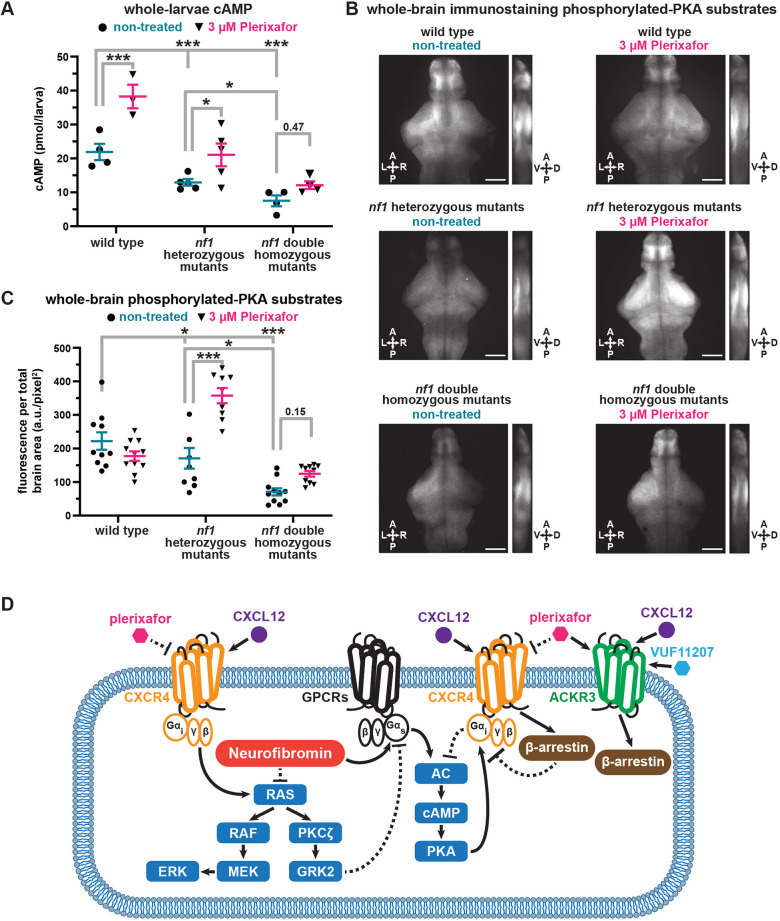
cAMP ELISA and phosphorylated PKA substrate immunofluorescence show Cxcr4 inhibition increases downregulated cAMP-PKA signaling in nf1 mutants. (A) cAMP levels±s.e.m. in 5 dpf wild-type and nf1 mutant larvae treated with 3 µM plerixafor. Data points represent averages of 3 technical replicates (sample sizes: WT control n=4, treated n=3; nf1 heterozygous mutant control n=5, treated n=5; nf1 double homozygous mutant control n=4, treated n=4). Two-way ANOVA showed statistically significant differences between genotypes [F(2,19)=33.79, P<0.001] and treatment groups [F(1,19)=24.87, P<0.001]. Tukey's and Šídák's adjusted P-values were used for multiple comparisons. (B) Representative phosphorylated-PKA substrate immunofluorescent images. Average intensity summation projections covering the whole brain. A, anterior; D, dorsal; P, posterior; V, ventral. Scale bars: 100 µM. (C) Phosphorylated-PKA substrate immunofluorescence. Values reported as arbitrary units of immunofluorescence per total brain area after subtracting background. Data points represent measurements from individual larvae (sample sizes: WT control n=10, treated n=11; nf1 heterozygous mutant control n=8, treated n=9; nf1 double homozygous mutant control n=11, treated n=10). Two-way ANOVA showed statistically significant differences between genotypes [F(2,54)=35.72, P<0.001], treatments [F(1,54)=16.41, P<0.001], and a statistically significant interaction between genotype and treatment [F(2,54)=16.83, P<0.001]. Tukey's adjusted P-values were used for multiple comparisons. *P<0.05, ***P<0.001. (D) Cellular signaling schematic highlighting interactions between drug treatments and known neurofibromin, CXCR4, and ACKR3 signaling mechanisms. Loss of neurofibromin is predicted to increase RAS and decrease cAMP signaling. Conversely, plerixafor treatment inhibits CXCR4 receptor signaling by blocking CXCL12 binding and stimulating β-arrestin recruitment which is predicted to decrease RAS and increase cAMP signaling. Our results show that in larval zebrafish, nf1 mutants have decreased cAMP-PKA signaling and that plerixafor treatment increases cAMP and PKA signaling in nf1 heterozygous mutants. A known negative feedback mechanism in which PKA undergoes cAMP-dependent stimulation of Gαi signaling could explain the interaction between plerixafor treatment, neurofibromin, and CXCR4 signaling. In cases where AC signaling is very low, like in nf1 double homozygous mutants, Gαi inhibition may also be decreased due to diminished cAMP-PKA-dependent negative feedback. Therefore, plerixafor treatment, which is predicted to block Gαi inhibition of AC would have limited effect. Alternatively, in the case of nf1 heterozygous mutants, where cAMP-PKA signaling is reduced to a lesser extent, there may still exist meaningful cAMP-PKA-dependent negative feedback. Therefore, blocking Gαi inhibition of AC with plerixafor has a measurable effect.

Figure Data
Acknowledgments
This image is the copyrighted work of the attributed author or publisher, and ZFIN has permission only to display this image to its users. Additional permissions should be obtained from the applicable author or publisher of the image. Full text @ Dis. Model. Mech.