
|
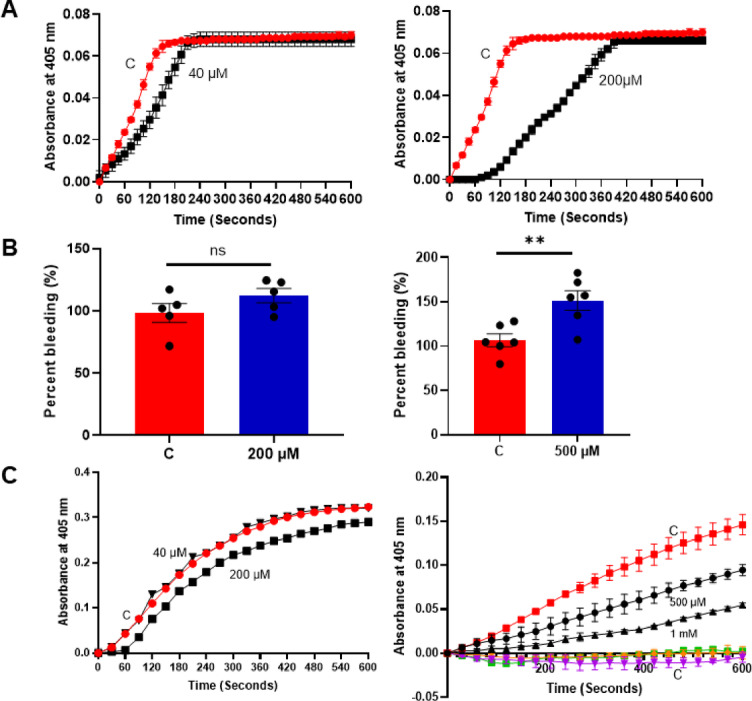
Fig. 6 Confirmation of antithrombotic activity of berbamine hydrochloride. (A) Kinetic fibrin formation curves in human plasma demonstrating inhibition of the kinetic prothrombin time (kPT) by berbamine hydrochloride. Reactions were performed in the presence of rabbit thromboplastin with vehicle control, C (red), 40 µM berbamine hydrochloride (black), and 200 µM berbamine hydrochloride (black). Absorbance at 405 nm was monitored over time. Data represent three independent samples; error bars indicate standard deviation. (B) Quantification of gill bleeding in zebrafish treated with 200 µM or 500 µM berbamine hydrochloride compared with vehicle control C. Six fish were analyzed per group. ns, not significant; **p < 0.01. (C) Kinetic factor VIIa activity assays in human plasma showing dose-dependent inhibition by berbamine hydrochloride. In the presence of rabbit thromboplastin, curves are shown for vehicle control (red), 40 µM (black), 200 µM (black), 500 µM (black), and 1 mM (black) berbamine hydrochloride. Corresponding reactions performed without thromboplastin are shown as control curves: No berbamine hydrochloride (green), 500 µM (purple), and 1 mM (orange) as controls, C. Absorbance at 405 nm was recorded over time. Data represent three independent samples; error bars indicate standard deviation.