
Fig. 4
- ID
- ZDB-IMAGE-260207-4
- Genes
- Publication
- Akhter et al., 2025 - KLHL13 functional defects cause neurodevelopmental disorder in humans that can be rescued via inhibition of AURKB in cellular and animal models
- All Figures
- Figures for Akhter et al., 2025
|
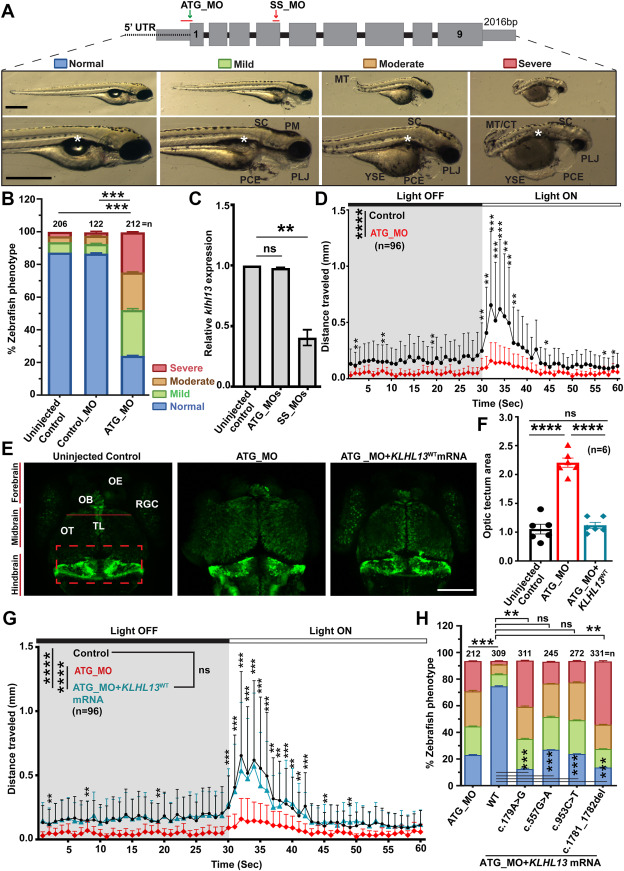
Fig. 4 Morpholino-mediated klhl13 knockdown caused developmental delay and macrocephaly in zebrafish. A. Schematic representation of the zebrafish klhl13 gene (top), along with the location of ATG-blocking morpholino (MO). Shown also are representative images (bottom) of resulting phenotypes in ATG_MO injected zebrafish larvae at 3 dpf. Based on the phenotypic severity, larvae were categorized into four classes MT/CT, malformed curled tail; PCE, pericardial edema; PLJ, protruding lower jaw; PM, populated head melanocytes; SC, scoliosis; YSE, yolk sac edema. White star marked absence of the swim bladder. Scale bar: 10 μm. B. The graph represents the percentages of controls (uninjected and control MO_injected larvae) along with klhl13 ATG_MO. A significantly reduced (∗∗∗P < .0001) number of ATG_MO-injected morphants was observed in the normal morphological class of larvae when compared with control groups. C. Graph representing the relative klhl13 expression in the ATG_MO and SS_MOs compared with the uninjected control, normalized to gapdh. SS_MOs showed a significant reduction in the relative klhl13 expression (∗∗P <.0044), whereas ATG_MO revealed a comparable klhl13 expression (ns: P <.0955) to uninjected control. D. Visual motor startle behavior analysis demonstrated delayed motor reflexes during the dark-to-light cycle transition stage in ATG_MO injected morphants compared with control-injected larvae (∗P <.01, ∗∗P <.001, ∗∗∗P <.0001, ∗∗∗∗P <.00001). E. Representative confocal images of 5 dpf neurod1-EGFP transgenic zebrafish larvae. Compared with the control groups (uninjected and control_MO-injected), larvae injected with ATG_MO exhibited a significantly enlarged brain (∗∗∗P <.00001; quantified in panel F), particularly in the optic tectum (highlighted by red lines). Additionally, the MHB appeared disrupted in ATG_MO-injected larvae (indicated by red boxes). Anatomical regions are labeled: CR, cerebellum; OB, olfactory bulb; OE, olfactory epithelium; OT, optic tectum; RGC, retinal ganglion cells; TL, torus longitudinalis. Scale bar: 200 μm. F. Coinjection of human KLHL13WT mRNA with ATG_MO significantly rescued the brain phenotype, restoring brain size and the integrity of the MHB (∗∗∗∗P <.0001 compared with ATG_MO alone). G. Visual motor startle behavior analysis showed a significant improvement in the overall locomotor activity in the human KLHL13WT mRNA and ATG_MO coinjected larvae in the light/dark transition period compared with the ATG_MO injected larvae (∗∗P <.001, ∗∗∗P <.0001, ∗∗∗∗P <.00001). H. The graph represents the number of ATG_MO injected morphants, as well as human KLHL13WT and NDD-associated variants mRNA coinjected morphants in various morphological categories. Microinjections of human KLHL13WT encoding mRNA, along with ATG_MOs, significantly rescued the number of larvae in the normal developmental class compared with ATG_MO alone (∗∗∗P <.0002). However, NDD-associated KLHL13 hemizygous variants (c.179A>G, c.557G>A, c.953C>T, and c.1781_1782del) encoding mRNAs did not rescue the phenotype when compared with the normal class of KLHL13WT encoding mRNA (∗∗∗P <.0001), supporting their pathogenic nature. Moreover, significantly more larvae in the severe class were found when ATG_MO was coinjected with human KLHL13 mRNAs harboring c.179A>G (∗∗P <.0012) and c.1781_1782del variants (∗∗P <.0052).