
|
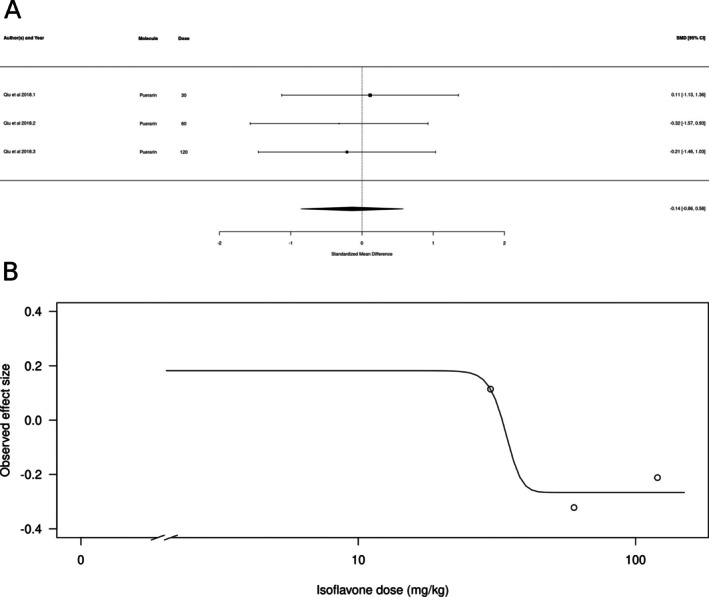
FIGURE 7
Subgroup analysis for isoflavones. (A) Forest plot showing the results of three comparisons examining the effect of an isoflavone on anxiety‐like behavior in animal tests. The figure shows the standardized mean difference (SMD) between control and isoflavone‐treated groups with corresponding 95% confidence intervals in the individual comparison, based on a random‐effects model. A negative standardized mean difference (SMD) corresponds to decreased anxiety‐like behavior, while a positive SMD corresponds to increased anxiety‐like behavior after isoflavone treatment. The overall effect size is denoted by the diamond symbol. (B) Estimated dose–response curve, based on the observed effect size (SMD) with increasing isoflavone dose. Each point corresponds to a single comparison from the forest plot. The curve was obtained by fitting generalized log‐logistic 5‐parameter models, with dose as an independent variable and the observed effect size SMD as the dependent variable.