
|
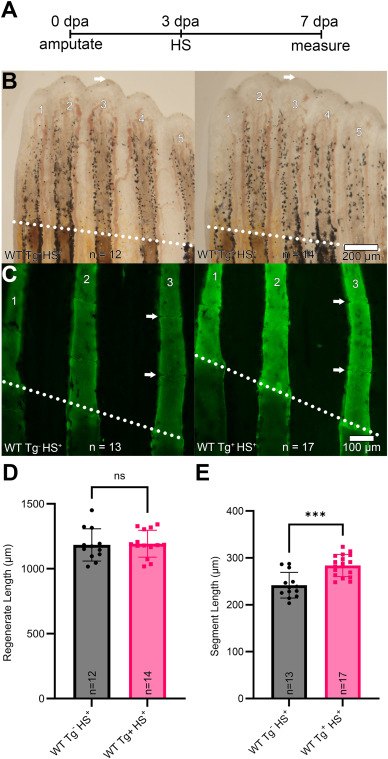
Fig. 2 Segment length is significantly increased in transgenic fish following overexpression of exogenous Xl-kcna5. A) Overview of experimental design. At day 0, fins from non-transgenic and transgenic siblings were amputated at the 50 % level and were systemically heat shocked at 37 °C for 1 h at 3 dpa. At 7 dpa/4 dpt, fins were stained with calcein prior to measurements of regenerate length and segment length. B) Fins were measured from amputation plane to distal tip of regenerate (white arrows) on the third-most dorsal fin ray. C) Segment length was measured as the distance between the first and second joints distal of the amputation plane on the third-most dorsal fin ray (white arrows). Amputation planes are denoted by the white dotted line. D) Quantification of regenerate length shows no difference following heat shock (unpaired t-test, p-value >0.99). E) Quantification of segment length shows significant increase in segment length following heat shock (unpaired t-test, p-value <0.0001). Graphs show measurements, mean, and standard deviation. Three independent trials were conducted. dpa, days post-amputation; dpt, days post-treatment.
Reprinted from Developmental Biology, , Seaver, A.W., Li, X., Iovine, M.K., Overexpression of potassium channel Kcna5 alters skeletal patterning in the zebrafish regenerating fin, , Copyright (2025) with permission from Elsevier. Full text @ Dev. Biol.