
|
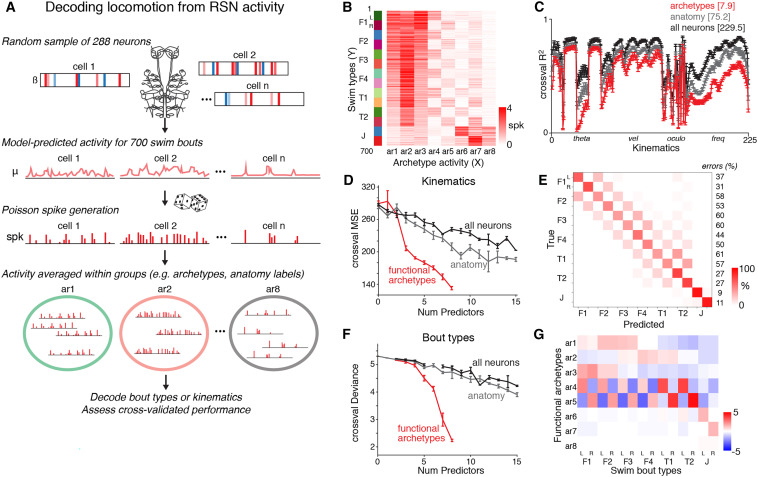
Fig. 7 Functional archetypes enable succinct decoding of swim type and kinematics (A) Schematic of decoding process. For each iteration, we pseudorandomly sampled 288 neurons with the same number of each anatomical type as is observed in individual fish. Next, the cells’ best GLM models were used to predict their activity across a random set of 700 swims, evenly sampled across bout types. Using this estimate of μ, spikes were emitted according to a Poisson process. Activity was then averaged across neurons belonging to each functional archetype and used to train a linear decoder. This was repeated for 10 iterations and performance evaluated using cross-validation. (B) Example of one iteration. For 700 swims (rows), bout types (color-coded on left) were predicted from functional archetype activity vectors. (C) Decoding performance (quantified as cross-validated R-squared) for motor kinematics. Mean number of predictors selected by LASSO decoder shown in square brackets. (D) Kinematic decoder performance (quantified as cross-validated mean squared error) as a function of number of predictors. (E) Confusion matrix for multinomial LASSO decoder predicting bout type from functional archetype activity. (F) Bout type decoder performance (quantified as cross-validated multinomial deviance) as a function of number of predictors. (G) Coefficients for bout type decoder. C–G show means across 10 decoding iterations; error bars show SEM.