
|
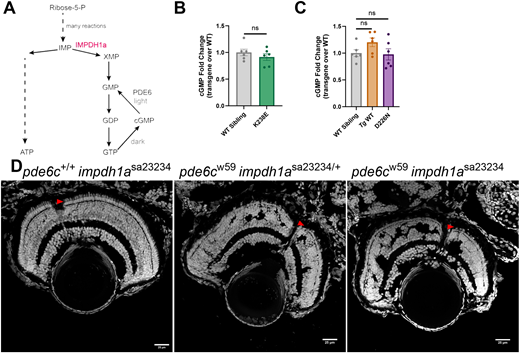
Fig. 4 Altering Impdh1a does not affect cGMP levels. (A) Schematic of de novo purine biosynthesis of cGMP, with IMPDH1a highlighted in red. In the light, phosphodiesterase 6 (PDE6) converts cGMP into GMP. (B) Steady-state levels of cGMP from K238E mutant zebrafish or WT siblings. Zebrafish with class 1 mutant, K238E, do not have raised steady-state levels of cGMP. n=6 for both groups. ns, not significant (P=0.36) (unpaired two-tailed t-test). Error bars are s.e.m. (C) Steady-state levels of cGMP from Tg WT, D226N mutant or WT zebrafish. Zebrafish with class 1 mutant, D226N, do not have raised steady-state levels of cGMP. n=6 for all groups. ns, not significant (P=0.079 for Tg WT and P=0.85 for D226N) (unpaired two-tailed t-test). Error bars are s.e.m. (D) Larval optic nerve slices with nuclei stained with Hoechst. Scale bars: 25 µm. An Impdh1a KO zebrafish shows no signs of degeneration, whereas the Pde6c mutant has signs of severe degeneration at 5 dpf. The Pde6c mutant, Impdh1a KO zebrafish also shows signs of severe degeneration by 5 dpf. Knocking out Impdh1 did not rescue or delay degeneration of the model with high cGMP. Red arrowheads point to the cone layer.