
|
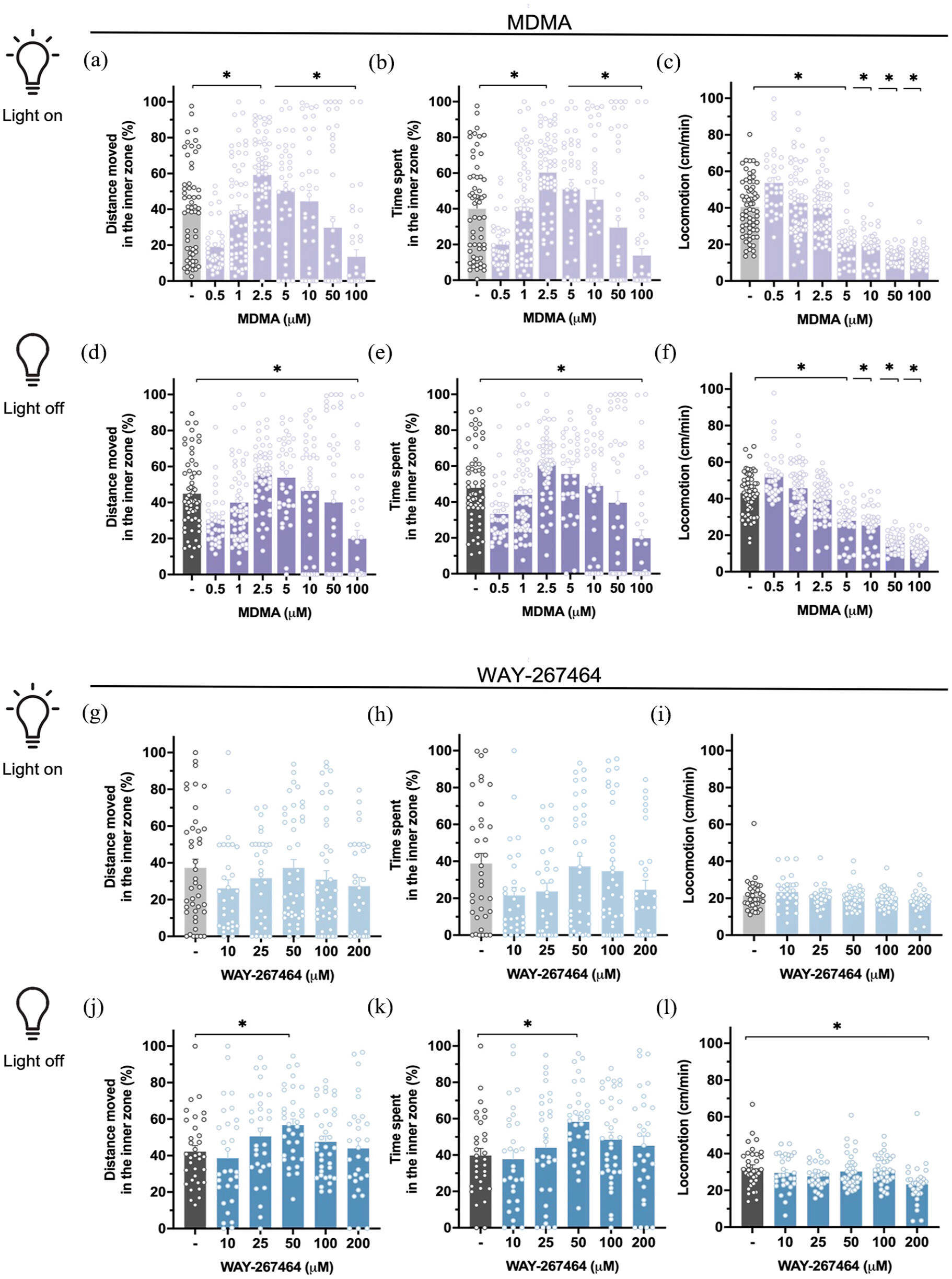
Fig. 3 MDMA and oxytocin receptor agonists show anxiolytic activity in fish. The novel environment exploration was conducted to measure anxiety levels in fish exposed to MDMA and oxytocin receptor agonist – WAY-267464 in both light and dark conditions. The study found that MDMA exhibited an inverted-U-shaped effect on anxiety behaviour. The lowest tested dose appeared to reduce the distance moved by fish in the inner zone, while with increasing concentration, the effect was the opposite before it diminished once again. Under light, a dose of 2.5 μM increased the distance moved significantly, whereas 100 μM reduced the distance moved in the inner zone (a). The same result was also observed when the time spent in the inner zone by fish was considered (b). Starting from the dose of 5 μM, MDMA inhibited fish locomotion (c). Under dark conditions, MDMA only reduced the distance moved (d) and time spent (e) in the inner zone at the dose of 100 μM and inhibited locomotion from the dose of 5 μM (f). Interestingly, WAY-267464 had no effect on anxiety behaviour under light conditions (g–i), however, was able to increase distance moved (j) and time spent (k) by fish in the inner zone under dark conditions. The highest dose tested of 200 μM resulted in reduced fish locomotion (l). Data were analysed using a one-way analysis of variance followed by Dunnett’s post hoc test (k). Kruskal–Wallis test with Dunn’s post hoc was used for datasets that failed normality testing or had significantly different variances (a–j, l). The confidence limit of *p < 0.05 was considered statistically significant, n = 29–66.