
|
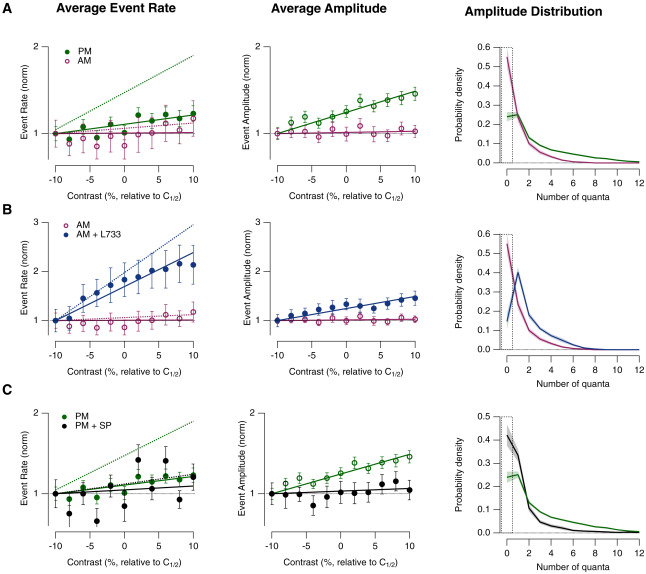
Fig. 5 Substance P modulates rate and amplitude codes (A) Comparison of coding by rate and amplitude in the morning (AM) and afternoon (PM). Left: contrast dependence of average event rate (points and bold line) compared with average rate of vesicle release (dashed lines, from Figure 4C). Middle: contrast-dependence of average event amplitude from the same dataset. Note that in the morning stimulus contrast is not encoded by changes in event amplitude. Right: the probability density of events of different amplitude, including stimulus cycles with no response (dashed box). Note the increased probability of larger MVR events in the afternoon (p < 0.001, chi-squared test). PM, n = 65; AM, n = 25. Each point shows the mean ± SEM. (B) Analogous comparison of event rate and amplitude in the morning, before and after injecting the NK1R antagonist L-733,060. Blocking the actions of endogenous substance P reduced the proportion of stimuli that did not elicit a response and increased probability of larger MVR events (p < 0.001 chi-squared test). Comparison of coding by rate and amplitude in the morning (AM) and morning + L733 (AM + L733). AM, n = 25; AM + L733, n = 11. (C) Analogous comparison of event rate and amplitude in the afternoon, before and after injecting substance P. Activation of NK1Rs increased the proportion of stimuli that did not elicit a response and reduced the probability of larger MVR events (p < 0.001, chi-squared test). PM, n = 65; PM + SP, n = 11. See also Figure S3.