
Fig. 8
- ID
- ZDB-IMAGE-240517-25
- Antibodies
- Publication
- Karas et al., 2024 - Removal of pomt1 in zebrafish leads to loss of α-dystroglycan glycosylation and dystroglycanopathy phenotypes
- All Figures
- Figures for Karas et al., 2024
|
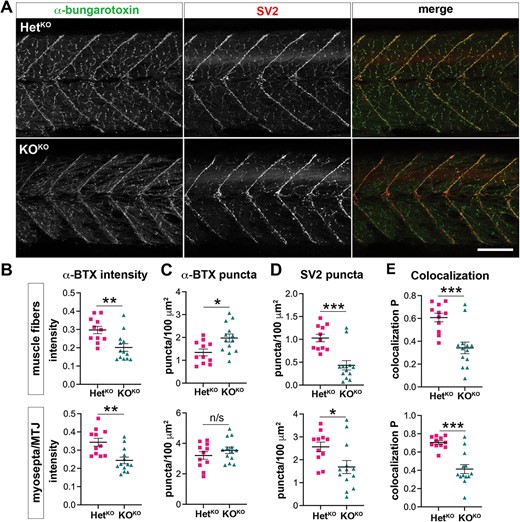
Fig. 8 Neuromuscular junction (NMJ) analysis in 10 dpf pomt1 KOKO larvae. (A) Whole mount staining with α-bungarotoxin (α-BTX, green) for acetylcholine receptors and SV2 for presynaptic sites showed both changes in intensity and organization in KOKO larvae. Scale bar: 100 μm. (B) α-BTX staining intensity was reduced both on muscle fibers in the myomeres and at the myosepta. (C) α-BTX puncta number was increased on the muscle fibers. (D) SV2 puncta were reduced at both sites. (E) The Pearson coefficient of colocalization between the two markers was significantly reduced in both. ***p < 0.001, **p < 0.01, *p < 0.05. Alt-text. This figure shows analysis of the neuromuscular junction in 10 dpf pomt1 knock-out fish obtained from knock-out mothers using alpha-bungarotoxin and SV2 staining. There is reduced intensity of alpha bungarotoxin and a reduction of SV2 puncta