IMAGE

Fig. 1

ID
ZDB-IMAGE-240203-4
Publication
Williams et al., 2024 - GPR68-ATF4 signaling is a novel prosurvival pathway in glioblastoma activated by acidic extracellular microenvironment
All Figures
Figures for Williams et al., 2024
Image
Figure Caption

Fig. 1

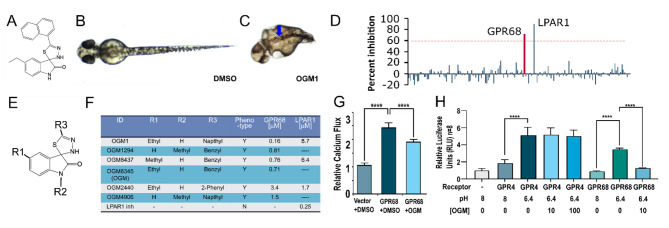
Ogremorphin is a highly specific inhibitor of GPR68. (A) Structure of OGM1 (5-ethyl-5’-(1-naphthyl)-3’H-spiro [indole-3,2’- [1, 3, 4]thiadiazole]-2-one). (B and C) Dorsal view of vehicle (DMSO)- and 10 µM OGM1-treated zebrafish embryo at 48 h post-fertilization (hpf). In contrast to the control embryo, OGM1-treated embryo showed abnormal melanocyte pigmentation, characterized by a striped pattern (blue arrow) restricted to the dorsal aspects of the embryo. (D) OGM1 only inhibited 2 GPCRs in a screen of 158 GPCRs (Data in Supplemental Table 2). (E and F) Core scaffold for OGM derivatives and structure activity relationship (SAR) analysis. Loss of LPAR1 activity did not correlate with loss of the zebrafish phenotype. Commercial inhibitor (inh) of LPAR1 (Ki16425, Sigma) also failed to recapitulate the phenotype. (G) Acidic stimulation of GPR68 expressed in HEK293 elicits a calcium response that is inhibited by OGM (N = 8). (H) Serum-responsive element-luciferase (SRE-luc) reporter by itself had low basal activity in 293T cells. Upon co-transfection with GPR4, luciferase activity increased with acidification but was not inhibited by OGM at 1, 10, or 100 µM. By contrast, when GPR68 was co-transfected with SRE-luc and stimulated by acidification, 10 µM OGM completely inhibited the signal. (n = 4, ****P < 0.0001)

Acknowledgments
This image is the copyrighted work of the attributed author or publisher, and ZFIN has permission only to display this image to its users. Additional permissions should be obtained from the applicable author or publisher of the image. Full text @ Exp Hematol Oncol