
|
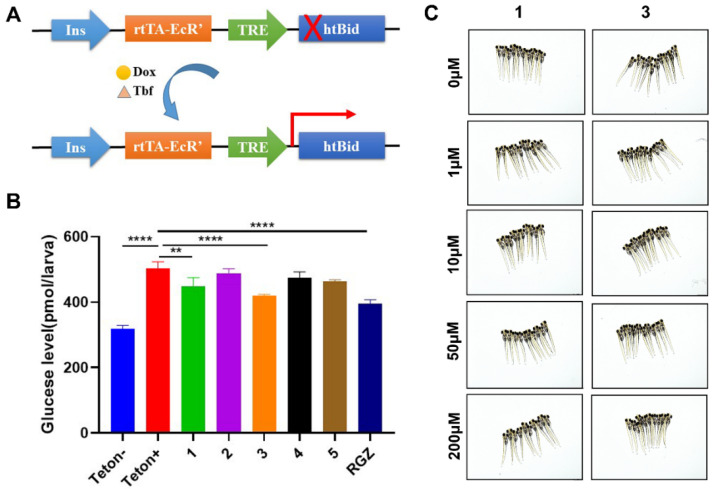
Fig. 6
Compounds 1 and 3 had hypoglycemic activity and low toxic effect in zebrafish: (A) Schematic diagram of β-cell ablation of transgenic zebrafish Tg(-1.2ins:htBidTE−ON; LR). In the transgene, the proapoptotic gene human truncated Bid (htBid) is under the control of a TRE-based promoter that is activated by a TE-ON driven by the zebrafish insulin promoter. After incubation with doxycycline (Dox) and tebufenozide (Tbf), the htBid will express and cause β-cell apoptosis. (B) The total free glucose level of 6 dpf Tg(-1.2ins:htBidTE−ON; LR) was treated with 10 μM of different compounds. After induction of the β-cell ablation, 10 μM of each compound was incubated with these larvae individually for 24 h, then their glucose levels were measured. Teton−, without β-cell ablation. Teton+, β-cell ablation without compound incubation. Rosiglitazone (RGZ) was used as a positive control. The values shown are means ± SEM from three independent experiments. ** p < 0.01, and **** p < 0.0001 by one-way ANOVA. (C) Compounds 1 and 3 did not show any toxic effect in zebrafish up to 200 μM, and the concentration of each compound was indicated.