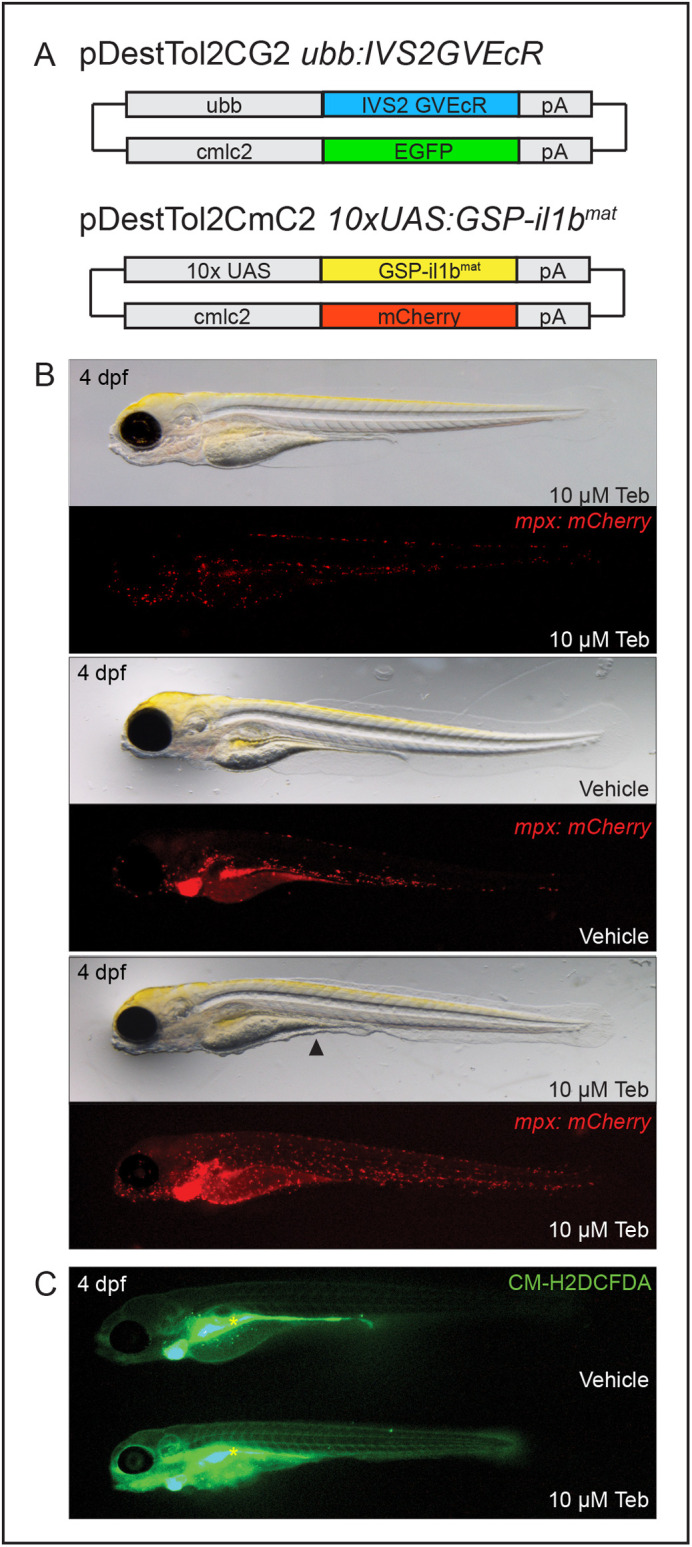
Genetic induction of ubiquitous GSP-Il-1βmat by the ecdysone mimic tebufenozide produces systemic inflammation. (A) Schematic of DNA constructs injected to make the Tg(ubb:IVS2GVEcR, cmlc2:EGFP) and Tg(UAS:GSP-il1bmat, cmlc2:mCherry) lines. Driver lines and responder lines are distinguished by green (cmlc2:EGFP) or red (cmlc2:mCherry) hearts, respectively. (B) Transgenic larvae, expressing the driver and responder transgenes in the Casper mpx:mCherry background, were induced with vehicle (DMSO) or 10 µM Teb at 2 dpf. Fluorescent stereoscope images taken at 4 dpf show neutrophils spreading throughout Teb-induced larvae, while brightfield images reveal a sickly appearance and degradation of the median fin fold (black arrowhead). Casper mpx:mCherry larvae exposed to 10 µM Teb and vehicle exposed Casper mpx:mCherry larvae positive for both driver and responder transgenes appear normal; n=20 for each condition. (C) Larvae were exposed to vehicle or 10 µM Teb at 2 dpf and examined for the formation of ROS using the cell permeant indicator CM-H2DCFDA at 4 dpf. Larvae from each condition were imaged in the same field by fluorescence stereomicroscopy, revealing heightened ROS production in Teb-induced larvae; n=5 for each condition. The gut rapidly absorbs and forms fluorescent product in both larvae (yellow asterisk).
Acknowledgments
This image is the copyrighted work of the attributed author or publisher, and
ZFIN has permission only to display this image to its users.
Additional permissions should be obtained from the applicable author or publisher of the image.
Full text @ Biol. Open
Your Input Welcome
Thank you for submitting comments. Your input has been emailed to ZFIN curators who may contact you if
additional information is required.
Oops. Something went wrong. Please try again later.