
Figure 7.
- ID
- ZDB-IMAGE-211207-96
- Publication
- Trofimenko et al., 2021 - Genetic, cellular and structural characterization of the membrane potential-dependent cell-penetrating peptide translocation pore
- All Figures
- Figures for Trofimenko et al., 2021
|
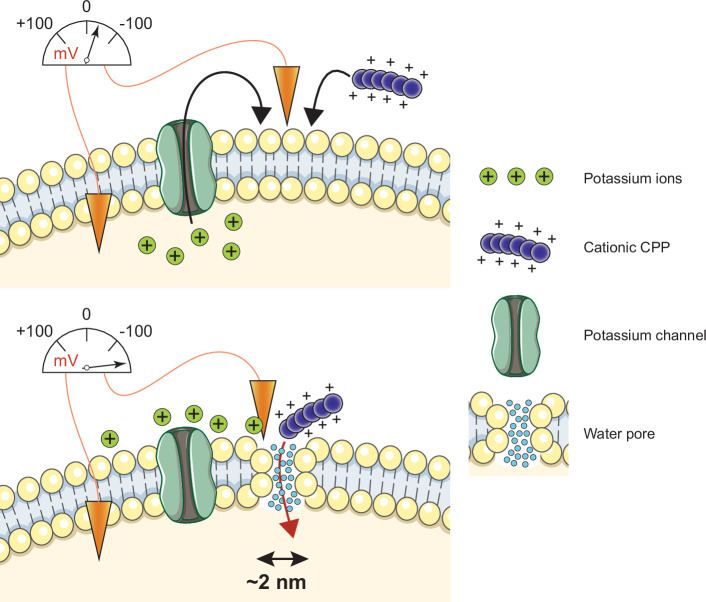
Figure 7.
Cationic CPP translocation across cellular membranes is favored by the opening of potassium channels or by hyperpolarizing drugs, such as valinomycin. This sets a sufficiently low membrane potential permissive for CPP direct translocation. When cationic CPPs bind to these already polarized membranes, they induce megapolarization (i.e. a membrane potential estimated to be –150 mV or lower). This leads to the formation of water pores that are then used by CPPs to enter cells.
Model of cell-penetrating peptide (CPP) direct translocation through water pores.