
|
Figure 1
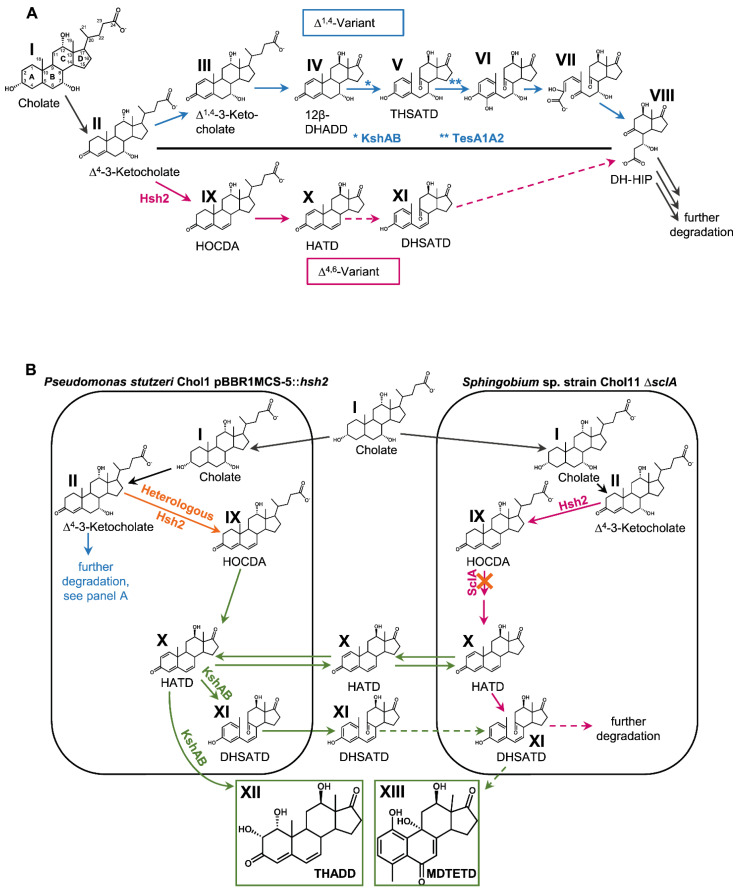
(A) Section of cholate degradation via the Δ1,4- and Δ4,6-variants of the 9,10-seco-pathway. For a detailed description and illustration of the pathway, including all known enzymes involved in bile salt degradation, see review [6]. (B) Principle of the co-culture designed for providing DHSATD (XI) to Sphingobium sp. strain Chol11. The heterologous expression of Hsh2 in P. stutzeri Chol1 leads to the accumulation of dead-end intermediates DHSATD (XI) and THADD (XII). The sclA deletion mutant strain Chol11 ΔsclA lacking the steroid C5-CoA ligase can use cholate only very slowly. Intermediates are produced inside the cells but can be found in the culture supernatant, most probably due to efflux. Black arrows: reaction present in both pathways, blue arrows: degradation via Δ1,4-pathway, red arrows: degradation via Δ4,6-pathway, orange arrows: changes in metabolism compared to wild types, green arrows: cross-feeding reaction, solid lines: known reactions, dotted lines: reactions found in this study. I: Cholate, II: ∆4-3-Ketocholate, III: ∆1,4-3-Ketocholate, IV: 12β-DHADD (7α,12β-Dihydroxy-androsta-1,4-diene-3,17-dione), V: THSATD (3,7,12-Trihydroxy-9,10-seco-androsta-1,3,5(10)-triene-9,17-dione), VI: 3,4,7,12-Tetrahydroxy-9,10-seco-androsta-1,3-5(10)-triene-9,17-dione, VII: 4,5-9,10-Diseco-3,7,12-trihydroxy,4,9,17-trioxoandrosta-1(10)2-diene-4-oate, VIII: DH-HIP (3,7β-Dihydroxy-H-methyl-hexahydro-indanone-propanoate), IX: HOCDA (12α-Hydroxy-3-oxo-4,6-choldienoate), X: HATD (12-Hydroxy-androsta-1,4,6-triene-3,17-dione), XI: DHSATD (3,12β-Dihydroxy-9,10-seco-androsta-1,3,5(10),6-tetraene-9,17-dione), XII: THADD (1α,2α,12β-Trihydroxy-androsta-4,6-triene-3,17-dione), XIII: MDTETD (4-Methyl-3-deoxy-1,9,12-trihydroxyestra-1,3,5(10)7-tetraene-6,17-dione).