IMAGE

Figure 2

ID
ZDB-IMAGE-210108-19
Source
Figures for Buatois et al., 2020
Image
Figure Caption

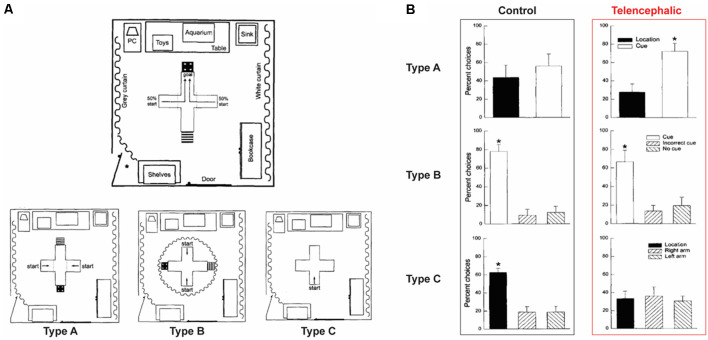
Figure 2

Spatial learning in goldfish. (A) The experimental setup was a cross-shaped tank. Fish were started either on the right or left arm (50/50). A cue card was associated with the rewarded arm during the entire training. Three types of probe tests were performed on a different group of fish that experienced the same training. Type A: Cue card, as well as room information, was available. Type B: Only the cue card was visible, room information was hidden thanks to a curtain. Type C: Cue card was removed, fish could only access the room information. (B) The bars present the percentage of choice for the location or the cue card during the probe tests. In this experiment, intact fish were used (control), as well as fish for which the telencephalon was ablated. In the probe test, similarly to zebrafish, control goldfish were able to use either the cue card or the location information. However, the telencephalon ablated fish were only able to use the cue card information. These results suggest a role of the telencephalon in configural memory retention, but not in elemental memory retention. The figure is adapted from figures in López et al. (2000a). Asterisks indicate significant (p ≤ 0.05) differences in the percentage of choices of the various arms.

Acknowledgments
This image is the copyrighted work of the attributed author or publisher, and ZFIN has permission only to display this image to its users. Additional permissions should be obtained from the applicable author or publisher of the image. Full text @ Front. Behav. Neurosci.