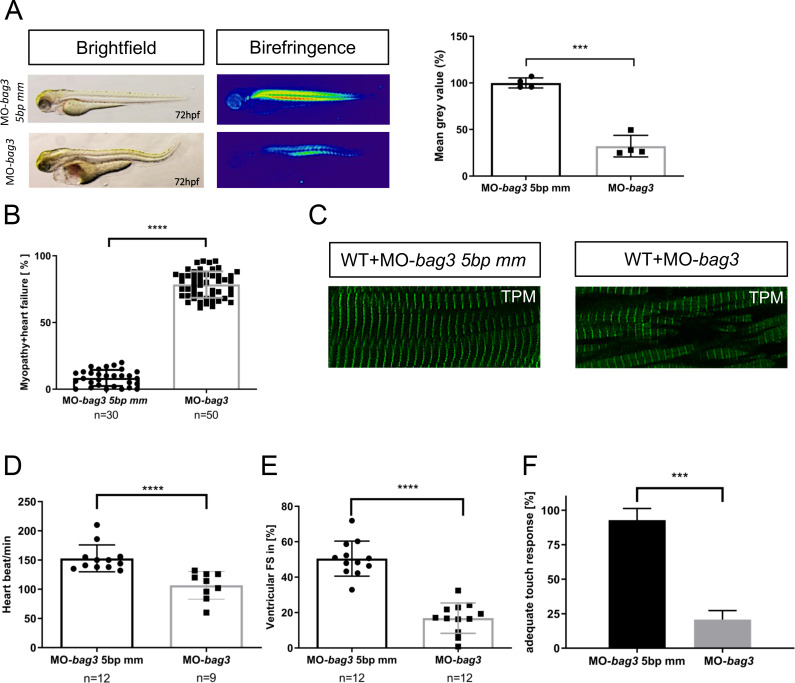
Targeted knock-down of Bag3 leads to (cardio-)myopathy in zebrafish (A) Brightfield and birefringence images of MO-bag3 and MO-bag3 5bp mm injected embryos developed (cardio-)myopathy phenotype at 72 hpf. The densitometric analysis of birefringence supports the presence of myopathy phenotype only in bag3 morphants. Representative samples are shown (n = 4, P = 0.0003 determined using two tailed t-test). (B)bag3 splice MO injected embryos develop (cardio-)myopathy phenotype (78.42±9.88%) whereas control-injected embryos developed no pathological phenotype (78.42±9.89%) (N = 3, n = 30/50 mean± SD P<0.0001 determined using two-tailed t-tests). (C) Tropomyosin immunostaining of MO-bag3 and MO-bag3 5bp mm embryos at 72 hpf shows that embryos injected with Bag3 splice MO develop muscle fiber disruptions. (D) Heart rate quantification of bag3 morphants reveals impairments at 72 hpf (N = 3, n = 9/12, P = 0.6026. HR 5bp-mismatch-MO injected embryos: 153±22.98 heart beat/min; HR bag3 morphants: 106±23.58 heart beat/min; mean ± S.D. P<0.0001 determined using two-tailed t-tests). (E) FS of bag3 morphant ventricles at 72 hpf is significantly reduced (16,88±8.56%), compared to MO-bag3 5bp mm injected embryos (FS: 50.48±9.90%) (N = 3, n = 12; Mean± SD P<0.0001 determined using two-tailed t-tests). (F) Touch evoked assay reveals significant reduction in responsiveness upon mechanical stimulus for bag3 morphants (20.78±4.46%) and not for 5bp-mismatch-MO injected embryos (92.78±4.40%) (N = 3, n = 40, mean ± S.D. P = 0.0005, determined using two-tailed t-tests).
This image is the copyrighted work of the attributed author or publisher, and
ZFIN has permission only to display this image to its users.
Additional permissions should be obtained from the applicable author or publisher of the image.
Full text @ PLoS Genet.
Your Input Welcome
Thank you for submitting comments. Your input has been emailed to ZFIN curators who may contact you if
additional information is required.
Oops. Something went wrong. Please try again later.