
|
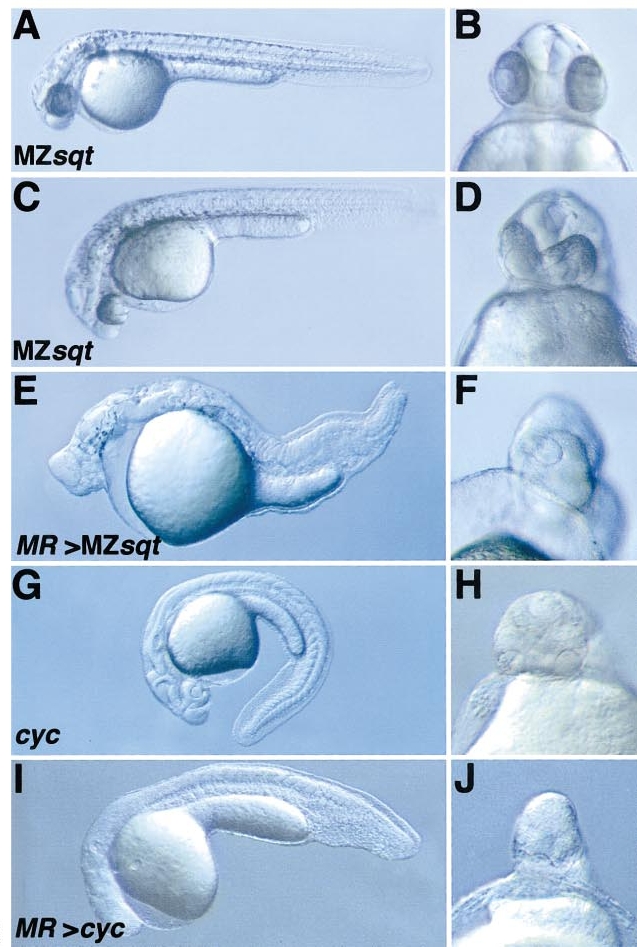
Fig. 5 tarMR enhances the phenotype of mutants with attenuated Nodal signalling. tarMR RNA was injected during the first cell cycle into mutant embryos and phenotypes of the injected embryos were analysed on 24- to 30-hpf live embryos presented as a lateral view from whole embryos (left column, anterior to the left) or as a frontal head view (right column). (A–D) Phenotypes of MZsqt mutants. The cross between homozygous individuals results in maternal–zygotic sqtcz35 mutants (MZsqtcz35) which exhibit a variable phenotype from almost normal (A, B) to more severe ones (C, D). When tarMR is overexpressed into MZsqtcz35 embryos, their phenotype is dramatically enhanced (E, F, 100%, n = 65). (G, H) Phenotypes of cycb16 homozygotes. Uninjected embryos exhibit a mild cyclopia and the absence of floor plate. When tarMR is overexpressed, their phenotype is slightly enhanced (I, J).
Reprinted from Developmental Biology, 241(2), Aoki, T.O., Mathieu, J., Saint-Etienne, L., Rebagliati, M.R., Peyriéras, N., and Rosa, F.M., Regulation of nodal signalling and mesendoderm formation by TARAM-A, a TGFbeta-related type I receptor, 273-288, Copyright (2002) with permission from Elsevier. Full text @ Dev. Biol.